Concerns over awarding of €50m contract for Irish Water’s call centre

Amid claims of favouritism, Social Democrats TD Catherine Murphy revealed how then-environment minister Phil Hogan was directly lobbied months before the four-year contract was handed out to the company involved.

Speaking during what was potentially the last leaders questions debate before the election is called, the opposition TD raised further questions about a €90m investment in the same company last November by a private equity firm which weeks earlier received €125m from the national pension reserve fund.

And despite denials by the firm involved, she said the situations raise “obvious questions of probity” and suggest favouring of the company for Government funds.

Freedom of Information Act documents obtained by Ms Murphy and seen by the Irish Examiner show MKC Communications’ political lobbyist and former Progressive Democrats official Stephen O’Byrnes contacted Mr Hogan’s then private secretary Yvonne Hyland on February 15, 2012.

The email said he was seeking a meeting with “Phil” as he was doing “some work with a Cork-based company called Abtran” and its marketing director, Ger Fitzgerald, wanted to meet to “get an opportunity of outlining to the minister the activities they undertake”.

Four hours later, Ms Hyland confirmed Mr Hogan wanted to meet and a February 27 discussion was arranged with Mr O’Byrnes and Mr Fitzgerald. A year later, in March 2013, Abtran was awarded the €50m contract to run Irish Water’s call centre.

Speaking in the Dáil, Ms Murphy said the decision needs to be examined as, despite Abtran being involved in the botched handling of the SUSI student grant scheme and the State property tax scheme, it was given the lucrative contract.

In a separate question to Tánaiste Joan Burton, Ms Murphy said that, in November 2015, a private equity firm called Carlyle Cardinal Ireland invested an undisclosed sum understood to be €90m in Abtran.

Weeks earlier, the private equity firm received €125m from the national pension reserve fund, leading the opposition TD to ask: “Do you know what that money is for? Are you concerned about what appears to be favouring of Abtran for Government funds?”

Ger Fitzgerald, the Abtran official who met with Mr Hogan, did not respond to calls, while his brother — Abtran CEO Michael Fitzgerald — was also unavailable when contacted.

While an Abtran spokesman confirmed the meeting occurred, he insisted the contracts followed strict public procurement guidelines.

“In common with many other companies, Abtran would occasionally request introductory meetings including from time to time, officials and ministers. These meetings would be requested openly and on the record as was done in 2012,” he said.

The spokesman described the discussions with Mr Hogan as “information meetings” needed because “this was a reasonably new Government”.

He said it had nothing to do with the upcoming Irish Water contract.

The spokesperson further said the investment in November 2015 and financial requirements to continue the Irish Water contract are entirely unconnected and that the private equity deal was “very simply on commercial merits”.

The Brussels office for Mr Hogan, who is now EU Agriculture Commissioner, said all queries about his time as a minister should be directed to the Department of Environment, which had yet to respond last night.

An Irish Water spokesperson said the contract decision “fully complies with public sector procurement guidelines” imposed after “a thorough Europe-wide public procurement process”.


January 2016 water meter resistance is strong with peaceful resolution in Silver Heights, Mayfield, Cork

Gerard Kavanagh, renowned Anti Water Charge protester,  shows in this video that in 2016 the resistance to water meters is alive and well.  Not only that but it is peaceful yet resilient because there is a sensible agreement in place between residents and contractors.  

Click photo to view the youtube video

Click photo to view the youtube video

Gerard in his facebook page says "Top of Silver Heights Avenue in Mayfield.  Only about I in 10 homes are accepting a meter.  This crew are respecting the posters.  They are even complying with the wishes of some residents who didn't want a meter or box but didn't have a poster up."


Replace pipes that 'poisoned' Flint water, lawsuit demands

Article from nr.news-republic.com  via fliuch.org

Matt Hopper holds and comforts Nyla Hopper, age 5, after she has her blood drawn to be tested for lead on January 26, 2016 in Flint, Michigan

Matt Hopper holds and comforts Nyla Hopper, age 5, after she has her blood drawn to be tested for lead on January 26, 2016 in Flint, Michigan

The downtrodden US city of Flint was poisoned in a misguided drive by penny-pinching officials to save money, a lawsuit filed Wednesday claimed, demanding the corroded lead pipes responsible for contaminating tap water be immediately replaced.

Officials are accused of ignoring months of health warnings about foul-smelling and discolored water, even as residents complained it was making them sick.

"In a failed attempt to save a few bucks, state-appointed officials poisoned the drinking water of an important American city, causing permanent damage to an entire generation of its children," Michael Steinberg, legal director of the American Civil Liberties Union of Michigan, said in announcing the lawsuit.

"The people of Flint cannot trust the state of Michigan to fix this man-made disaster and that is why court oversight is critically needed."

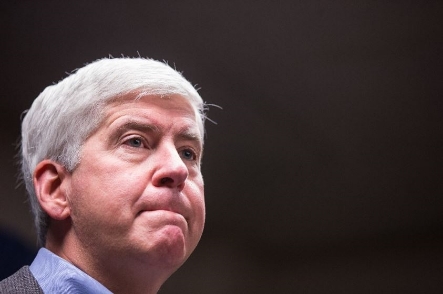
Michigan Governor Rick Snyder speaks to the media regarding the status of the Flint water crisis on January 27, 2016 at Flint City Hall in Flint, Michigan

Michigan Governor Rick Snyder speaks to the media regarding the status of the Flint water crisis on January 27, 2016 at Flint City Hall in Flint, Michigan

Governor Rick Snyder -- who faces calls to resign over his handling of the scandal -- appointed a team of outside experts Wednesday to help the state resolve Flint's water crisis and deal with the long-term health impacts.

In an interview with CNN, set to air Wednesday evening, he admitted the number of children harmed by lead in the water could be much higher than tests have so far revealed.

"There could be many more," the governor told CNN, "and we're assuming that."

Snyder vowed at a news conference to help "address the damage that's been done" in the predominantly poor and black city of 100,000.

But he stopped short of promising to replace the pipes, which began releasing lead after Flint switched to a cheaper but dangerously corrosive water supply.

"It's a lot of work to take out pipes, to redo the infrastructure," Snyder told reporters.

"The short-term solution is to hopefully recoat, and have it validated by third parties so we know the water is safely coming out."

$1.5 billion fix

Tears stream down the face of Morgan Walker, 5, as she gets her finger pricked for a lead screening on January 26, 2016 in Flint, Michigan

Tears stream down the face of Morgan Walker, 5, as she gets her finger pricked for a lead screening on January 26, 2016 in Flint, Michigan

Lead exposure is harmful to everyone, but it can have devastating impacts on young children by irreversibly harming brain development. It has been shown to lower intelligence, stunt growth and lead to aggressive and anti-social behavior.

Water treatment plants across the United States are required to closely monitor lead levels in tap water and use chemicals to reduce acidity and coat pipes to prevent corrosion.

The state of Michigan is working to map out exactly where the old lead pipes are in Flint so it can "come up with the proper priorities about how we replace that infrastructure," Snyder said. But he said that was a long-term project and declined to comment on the lawsuit.

Flint's mayor has estimated that the cost of fixing the damage done to the city's infrastructure by the corrosive water could reach $1.5 billion.

The cash-strapped city was reportedly hoping to save $5 million over two years by drawing water from the Flint River beginning in April 2014 rather than continuing to buy it from nearby Detroit.

The state's environment department approved the switch even though the city's treatment plant was not able to produce water that met state and federal standards.

It cost $12 million to switch Flint back to the Detroit water system in October after a local pediatrician released a study showing that the number of children with elevated blood-lead levels had doubled from 2.1 to four percent.

Nation's pipes need replacing

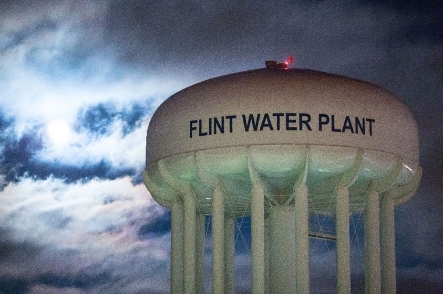
The City of Flint Water Plant is illuminated by moonlight on January 23, 2016 in Flint, Michigan

The City of Flint Water Plant is illuminated by moonlight on January 23, 2016 in Flint, Michigan

Activists and environmentalists say the state now needs to spend whatever it takes to make sure the water is safe to drink.

"For years the state told us we were crazy, that our water was safe, which wasn't true," said Melissa Mays of Water You Fighting For, a Flint-based organization which joined the American Civil Liberties Union and the Natural Resources Defense Council in filing the lawsuit.

"For the sake of my kids and the people of Flint, we need a federal court to fix Flint's water problems because these city and state agencies failed us on their own."

Replacing all the lead pipes in Flint would take years and cause major disruption for residents because roads would need to be shut down to dig them out of the ground, said Greg DiLoreto of the American Society for Civil Engineers.

But while short-term fixes might be able to resolve Flint's lead problems for now, replacing those pipes is something that Flint -- and most other American cities -- has to start planning for, he told AFP.

A large proportion of the nation's water systems were built in the early 20th century and some pipes date back to the late 1800s.

"No engineer designed any system to last 150 years," DiLoreto said in a telephone interview.

"This is like your house. At some point you're going to have to put a new roof on it."