Jobstown trial: prosecution of schoolboy a ‘recipe for totalitarianism’

Teenager charged with false imprisonment of Joan Burton and Karen O’Connell

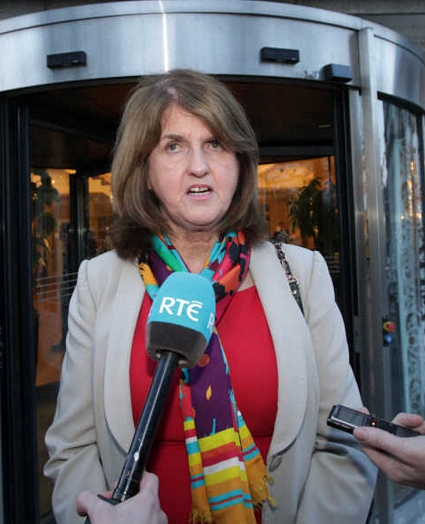
Protesters outside the Children’s Court in Dublin’s Smithfield during the trial of a 17-year-old for false imprisonment. Photograph: Gareth Chaney/Collins

The prosecution of a schoolboy accused of the false imprisonment of then Tánaiste Joan Burton is a “recipe for totalitarianism”, his barrister has argued.

On Tuesday, Judge John King adjourned the trial until October 21st to decide if he is going to throw out the case. The 17-year-old’s legal team have contended that it is not in accordance with Irish or European human rights laws and that the State has not made out a case to answer.

The youth denies falsely imprisoning the former Labour Party leader and her advisor Karen O’Connell, who were allegedly trapped in two garda cars for three hours during a demonstration at the Fortunestown Road in Jobstown, Tallaght, on November 15th, 2014. He was aged 15 at the time.

The Dublin west TD had been at a graduation ceremony at An Cosan education centre when a water charges protest took place outside. She told the court earlier that she was frightened and did not think she had the alternative of being able to get out of Garda cars surrounded by people shouting abuse and banging on windows.

The State has closed its case and, on Tuesday, the boy’s legal team asked Judge John King to dismiss the charges. It was day four of the trial at the Dublin Children’s Court.

The boy’s barrister Giollaoisa Ó Lideadha SC told Judge King the case is “unprecedented” and is a “recipe for totalitarianism. If the charge of false imprisonment is not dismissed, that would amount to a failure to vindicate the constitutional rights of the accused, failure to uphold the right to fair trial, failure to uphold the obligation on the authorities not to abuse their powers and not to act arbitrarily or in a manner inconsistent with basic fairness”.

Counsel has also submitted that the prosecution has failed to prove their case beyond the necessary proof of reasonable doubt and they had used a too literal interpretation of the law on false imprisonment in a case where a person was detained for seconds in one instance and minutes in another.

He said his client makes no apology for the demonstration, but certainly did not want any personal trauma to be caused. Applying for a dismissal, he argued that the prosecution has not proved that a criminal case has been caused.

He said the teenager “was never told he was committing an offence or committing a public order offence or an offence of an entirely different magnitude, false imprisonment. My submission is that the decision to charge in relation to this matter in the first place was not in accordance with constitutional rights and the European convention on human rights”.

He said the case touches on the right to protest, freedom of expression and freedom of assembly. He said the teen had nothing to do with any of the unpleasant things that happened such as screaming and throwing objects while the slow march was taking place.

The prosecution case is that the former Tánaiste and her advisor were detained by the actions of the teenage defendant, in conjunction with the actions of others.

Replying to the points raised by the defence, prosecuting counsel Tony McGillicuddy BL said the video evidence showed the teenager had a megaphone and was encouraging people to sit down around the cars. He said there was evidence that the first garda car was blocked. At a Garda 4x4, the boy used the megaphone to encourage others to sit down and he sat down also, he said.

He argued that to call it an innocuous peaceful protest is wrong when you see the evidence from Joan Burton, her advisor, gardai and the footage shown in court.

Judge John King said the case will resume next month. He said he wanted to read the case law furnished by the defence and to review the evidence and the submissions in detail. He told the prosecution and defence teams that he will give a decision when the case resumes on October 21st.

Source: Irish Times, Sept 27, 2016
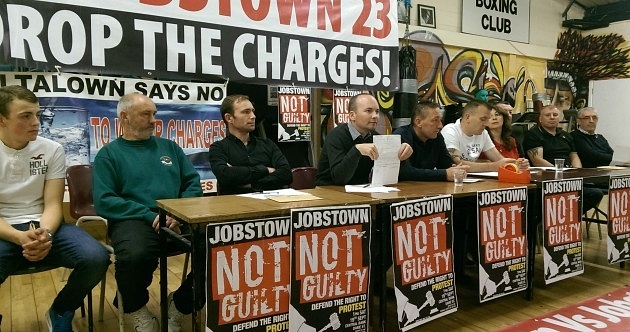

Establishment begins an all out assault on the right to protest - Jobstown

A court case began this week in the Children's Court, Dublin against a juvenile, the first member of 18 protesters charged with falsely imprisoning Joan Burton and her adviser during an anti water charge protest in November 2014.  The accused was 15 at the time of the water protest at Fortunestown Road in Jobstown in Tallaght, Dublin.  The last day of this first case is set for 27th September when, as the jargon goes, 'a verdict will be handed down'.

Many might not read much into this little case in the juvenile court but many would see itas the State flexing it's muscle, using the full force of the legal system to come down hard on a working class community and the general principle of the right to protest.   In this first case it is picking on a juvenile breaking up the case into separate cases.  Possibly it believes that this is potentially a weak link in the Jobstown Not Guilty Campaign.

The case against the 18 Jobstown protesters accused of falsely imprisoning Joan Burton is no minor matter.  If convicted the accused could receive lengthy prison sentences.  No matter what this case will have historic relevance and could have serious intended consequences for anyone protesting.


The State's historic repressive apparatus

How would one look at the State's assault against the working class in 1913 when 'William Murder Murphy', a journalist, a member of parliament and prominent bussinessman initiated the Dublin Lockout of 1913

Central to that dispute was the 'right to unionise'.  Central to the jobstown case is the 'right to protest'.  But common to both is the assault on our freedom. 

We wonder how former minister Joan Burton would react to a similar nickname?


Follow the case

A good place to read about the case is the excellent coverage in thejournal.ie.   Hopefully The Journal will continue and keep us informed of all future Jobstown cases.  Of course you will get full coverage in Jobstown Not Guilty facebook page


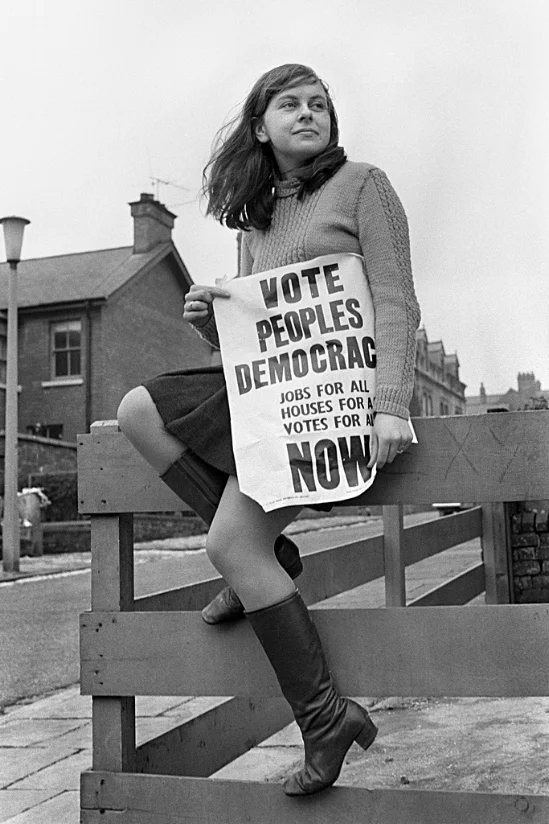
‘A Terrible State of Chassis’ - A Lecture by Bernadette Devlin McAliskey, Field Day Annual Lecture

A Lecture by Bernadette Devlin McAliskey, Introduction by Emer Nolan, Q&A with Michael Farell

It will take place on Friday 30th September in The Playhouse, Derry.  Tea and coffee reception 7pm, lecture starts 8pm.


photo: Picssr

Seamus Deane gave the first of the annual lecture series in his honour last year.

His work is not, as he himself has stated, devoted to a rewriting of the Irish past but to a writing of the Irish present.

Founder and editor since 1995 of the Field Day Review, as he had earlier been of the Field Day pamphlets in 1983-88, he has made his poetry, fiction, scholarship and criticism, particularly in latter years in the form of the essay, a meditation on the need, in a debased political system, to follow the dictum: ‘When in Rome, do as the Greeks do.'

Bernadette Devlin McAliskey is from Cookstown, Co. Tyrone. While still a student at Queen's University, she and her colleagues in the newly-formed People's Democracy transformed political resistance in the Northern Irish statelet by spearheading a socialist, anti-sectarian, mass movement for change. Her celebrity began when she was elected to Westminster for Mid Ulster in 1969 - then the youngest woman MP ever - and when she became a leading organizer on the barricades in Derry during the Battle of the Bogside.

In an electrifying maiden speech she declared herself, as the second Irish woman elected to Westminster, to be in the same tradition of feminist republicanism as the first, Constance Markievicz. Later, she was active in the Smash H-Blocks campaign, was seriously wounded in 1981 in an assassination attempt by Loyalists and British paratroopers, yet continued her sustained left-wing critique of many key developments in Ireland since, including the Peace Process.

‘Bernadette' as she is still known, currently works supporting migrants' rights in South Tyrone and remains Ireland's finest political orator, the unforgettable voice of the Troubles.

Source: derryplayhouse.co.uk