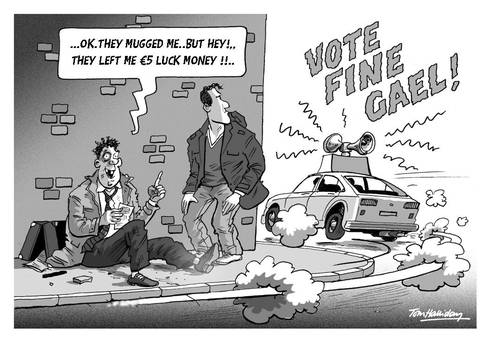
Enda is ruthlessly good at some things

When you see how they treat their friends, you understand how they feel about us, writes Gene Kerrigan

Gene Kerrigan

Gene Kerrigan

Cartoonist: Tom Halliday

Cartoonist: Tom Halliday

We know we're being manipulated. But financially we're somewhat better off. So, we live with the manipulation.

That's just how things are done.

The Fine Gael/Labour Budget is designed to increase inequality, and we know that's unfair. But they gave us some goodies. And that's better than having even more charges, levies and cuts imposed on us. So, we accept the unfairness.

We know the Budget is about using public money to persuade us to elect Fine Gael and Labour candidates. But the side effect is that this misuse of public money puts some cash in our pockets. So, we accept it.

But the scale of the manipulation is epic. They've made a mess of the hospitals, dealing with homelessness is beyond their talents, Irish Water is an expensive joke. But, in the matter of its own electoral prospects, the Government has behaved with an efficiency and ruthlessness that's almost admirable.

Look, for example, at how it stitched up the Fiscal Advisory Council.

The FAC is supposed to examine government economic policy and advise on whether it obeys certain rules. It's part of the apparatus of austerity. We here at Soapbox are not big fans of the FAC, but they're terribly sincere people. They see their role as one of crucial public service.

And the Government openly treats them with contempt.

At best, ministers can use the FAC as intellectual cover for unpopular policies. Otherwise, the FAC is ignored.

Here's a line from the Irish Examiner last week: "The chairman of the Irish Fiscal Advisory Council [Professor John McHale] has denied being put back in his box by the Department of Finance".

Disrespectful, but accurate. The Government gave the FAC plenty of notice that in this Budget it would have €1.5bn to use for political manipulation. The FAC looked at government plans and gave the thumbs up. All within the rules. And not economically damaging, the FAC concluded.

Then, with days to go, Michael Noonan found another €1.5bn down the back of the sofa. He'd have a total of €3bn to buy votes with.

"Ah here," said Professor John McHale, or words to that effect.

He had two points to make. One: this seemed to break EU rules on spending; and, Two: in his view, it was economically risky.

Agree or disagree, the man is not a dope, and he had a job to do. So, he spoke up.

He was instantly shot down. As the Examiner explained: "The Department of Finance revealed it had reached a separate deal on the deficit with the European Commission earlier this year." McHale was using out-of-date figures.

Back in your box, professor.

And McHale, ever the gentleman, immediately conceded that his figures were indeed out of date. Why, though, he wondered aloud, hadn't the department told him of the deal with the EU?

Precisely because it needed to ambush, isolate and discredit you, professor. If you read Soapbox you'd know that our leaders did a deal with our EU overlords. For almost five years they were unhesitatingly obedient to the EU Commission and the European Central Bank. In return, they were now to be allowed some leeway in spending, to enhance their electoral chances.

McHale's main point - that this was economically risky - was lost in the story that he had "retracted" his statement, when he found out relevant information had been withheld from him. Back in your box, professor - take your misgivings about government policy and FAC off.

And this is how they treat their friends.

Back in 2008, this column made the point that the main fight would be over who would pay the cost of the recession, the cost of recovery. The wealthy broke the country, driven by greed. The politicians saw their job as repairing the economy without changing any of the structural inequalities in which they so firmly believe.

They protected the freedom of the market - which means the freedom of the bankers, the freedom of the big landlords, the tax avoidance of the mega-corporations. At the United Nations, as some countries sought to protect their citizens, the Irish Government voted to protect vulture fund capitalists.

They protected the two-tier health system and the class-ridden education system. They protected the use of the housing market as a casino for wealthy gamblers. And they sought to create a private company that would act as a conduit for selling our water supplies to the highest bidder.

They reduced our share of income and thrashed our pensions. They ruined countless lives by cutting services that helped the low paid and the periodically unemployed hold their lives together.

Now, they faced an election.

Fine Gael's core support has been solid. That support expects and backs right wing policies. Labour's supporters expected better. The young people who helped them get elected in 2011 melted away, once burned.

They had this one Budget to rescue the double-act - or Fine Gael will have to find a new partner, perhaps Fianna Fail.

We all know what they did.

It's not that suddenly these extra hundreds of millions popped up out of nowhere. It's not like Brendan Howlin opened a drawer and found a big bundle of money. It's not like Michael Noonan did his sums again in September and realised he could afford a goodie here and a goodie there.

That money has been gathered together. It has been accumulated over at least a year, probably two. Carefully set aside, earmarked for the pre-election period.

Meanwhile, they kept tightening the screws.

It was never about what the economy could afford, and when. It was about hoarding goodies to be dispensed at the last minute.

And so far it has worked. After the past week, they are stronger than ever.

The Opposition is ineffective. They taunt the Government, but they cannot challenge it - Fine Gael and Labour, after all, are merely implementing the Fianna Fail strategy, with more cunning than Fianna Fail ever managed.

As we move into election mode, the weirdness increases. Enda Kenny goes on The Week in Politics and calmly abandons water charges. He has begun speaking of a "contribution", as though the Government is passing a basket around and we can drop in a fiver or a few cents, depending on how we feel.

He is allowed to repeat this, as though he's not making things up. He now praises Irish Water for the number of leaks its meters have detected. This should have been one of the stories of the year - 'Taoiseach Admits Spending Half a Billion on Leak Detection Machines'.

Instead, in this fantasy that Fine Gael/Labour have created, Irish Water is being touted as a success story.

At the last election, Enda Kenny took personal responsibility for solving the hospital trolley scandal. Things are worse than ever. His Minister for Health shrugs, as though he's baffled by it all. And amid the blood and the piss on the A&E floor, a smiling Taoiseach is allowed praise himself for the "stability" he has created.
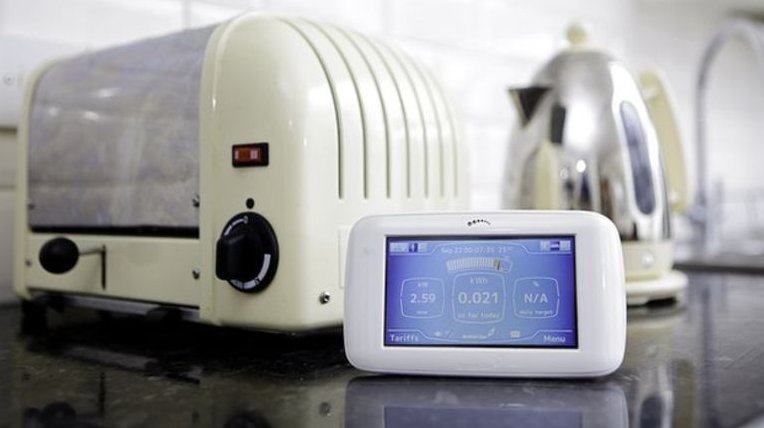

Global Smart Meters Market Is Expected To Reach $22,177 Million By 2020

The global market for smart meters is expected to reach USD 22,177 million by 2020. Smart meters provide two-way communication and benefits including time-based rates, faster power outage detection and resolution, and dynamic pricing among others. Initiatives by regulatory authorities to establish smart grids and ensure energy efficiency are expected to be a considerable growth driver over the forecast period.

Benefits of smart meter installations resonate across the value chain, which is also a key driving force for the industry. Customers can potentially cut down costs by lowering peak hour electricity demand; additionally, on-site visits and manual readings can be eliminated. Inconsistencies in deployment on a regional level coupled with lack of standardization in technology are expected to pose a barrier to market growth.

Further key findings from the study suggest:

Global smart meter shipments were estimated to be 59.6 million units in 2012, which is expected to reach 165.5 million units by 2020, growing at a CAGR of 9.8% from 2014 to 2020.

Residential applications accounted for 82.6% of overall shipments in 2012, and are expected to remain the largest segment in terms of volume over the next six years. This segment is also expected to be the fastest growing, at an estimated CAGR of 10.0% from 2014 to 2020. However, in terms of revenue, they accounted for significantly smaller market share in 2012. This can be primarily attributed to high technical requirements and selling prices of industrial and commercial smart meters.

Asia Pacific is expected to be the largest regional market in terms of volume and revenue over the forecast period, and accounted for 49.2% of overall shipments in 2012.

Europe is expected to be the fastest growing market in terms of revenue, at an estimated CAGR of 9.4% from 2014 to 2020.

The market in Europe is expected to contribute significantly to global revenue generation, which can be attributed to high selling prices as compared to other regions.The global smart meters market consists of a large number of participants such as Itron, Landis+Gyr, Elster, and Sensus among others.

Mergers and acquisitions and vertical integration have been the key growth strategies followed by industry players in order to gain market share and expand their product portfolio. High demand from emerging markets on account of energy efficiency programs and growing need for enabling smart homes is expected to positively impact profitability.

Other companies operating in the market include Jiangsu Linyang, Holley Metering, Echelon, Aclara, etc.

Original Article http://www.digitaljournal.com/pr/2710240


Smart Meters, Watching Our Lives


Under the guise of climate change advocacy which pretends to save the planet from a non-existent anthropogenic global warming, people across the globe have been forced by utilities and their governments to accept smart meters as readers of their electricity consumption. I called these smart meters in my book, “U.N. Agenda 21: Environmental Piracy,” drones attached to our homes.


Smart meters are being deployed without debate and without the informed consent of homeowners. They inspect homes 24/7 through several pulses a minute and without a warrant, over-bill, cause home fires, result in environmental and health problems, are vulnerable to hacking, and data obtained from such smart meters are sold to third parties without homeowners’ consent.

During peak usage, the utility company can turn off the power several hours a day, adjust the thermostat from afar, or turn off entire grids in an “emergency” situation when they run short of electricity. It is too expensive to build excess capacity storage facilities.

Smart meter removal from one’s home may not be enough. Within a five square mile area there is a collecting point of information from all meters and a transmitter receives information from all the collecting points of information within 125 miles of its location. This transmitter sends all collected data to a master location, the “mother ship,” where everyone’s information is stored, analyzed, and sold to a third party who is interested in the household’s pattern of usage, consumption of electricity, or possibly “illegal” activity in that home.

In addition to electric bills doubling in many places even though consumption had remained the same or had been reduced, customers are being “nudged” via carefully crafted notes added to their monthly bills for their shameless and selfish use of the planet’s resources.

Some individuals and townships have gone to court and managed to obtain permission from their utilities to opt-out of the installation of smart meters, in exchange for a monthly reading fee which can be quite high in various places. Others were not successful and, after seeing their utility bills double, have filed a class action suit against their utilities. Such was the case of California.

In the Dominican Republic, angry customers of Edenorte have ripped their smart meters from their sockets because their electric bills have doubled even though they were sold a false bill of goods that digital meters would give them a more accurate reading of their usage. They were also unhappy that their “electricity was being cut off out of nowhere and they would have no power for a couple of hours every day, sometimes more.” Edenorte was a “free entity,” no longer under government regulation.

A video obtained by Josh Del Sol, the producer of the award-winning documentary, “Take Back Your Power,” shows the public outrage; people are turning over electric company trucks, slashing their tires, breaking windows, and piling up hundreds of removed smart meters in front of the electric company’s offices in the city of Peidro Blanca.

The residents complained that “the lower their consumption, the higher the bills.” The claim is not without merit as utility companies billing schemes tend to punish those who consume less and reward those who consume more. One of the protesters in the video asks, “How is it possible in X days for it to register 1041 kWh?” He continues, “This is why we say that they have rigged these meters to benefit them.”

In San Antonio, KENS 5 reported that “CPS Energy admitted to overcharging customers who recently have had smart meters installed,” affecting hundreds, possibly thousands of angry customers.

K.T. Weaver, of SkyVision Solutions, wrote about the Sacramento Municipal Utility District (SMUD) Board meeting which took place on August 20, 2015, at which meeting, President Rob Kerth said, ”Any efforts or investments made to avoid smart meters are entirely wasted. I know that change can be unnerving, especially when it comes quickly, but giving into hysteria and falling victim to the alarmists and the charlatans of our era will not improve anyone’s lives.”

Failing to demonstrate how charging customers more for the same energy consumption and reducing their access to electricity, affecting their privacy and good health, is going to improve anyone’s lives, it is glaringly evident that smart meters are a convenient way to control our energy use and our independence.

Having attended a utility regulator hearing three years ago, I heard testimony after testimony of Americans who were made really sick by their smart meters, or their homes caught fire and went up in flames.
Smart meters, heavily subsidized by the government, are sold to the public under the false narrative of convenience, modernization, cheaper energy, expedience, and better service.

Smart meters are convenient ways to spy on citizens, charge more per kWh of consumption, reduce consumption by cutting power delivery, replace coal-generated and cheaper electricity with more expensive “renewable” energy, control the population and its health, reduce costs for utilities who no longer have to worry about storing excess capacity in additional storage plants, reduce costs of wire maintenance under and above ground, and eliminating jobs for meter readers.

Unbeknownst to most of us, homes are now fitted with smart water meters, smart gas meters, and smart appliances that communicate with each other and with the “mother ship.”

Article found on http://fliuch.org/smart-meters-watching-our-lives/