Barcelona votes for public control of water

Barcelona En Comú’s motion to remunicipalize the city’s water service has been supported by an absolute majority of the City Council

For the first time, a large majority of the Barcelona City Council supports ending the private management of water in our city. Barcelona En Comú believes that water is a human right, a basic service and a common good that should be under public, democratic control.

On Friday, November 25th, Barcelona En Comu presented a motion to take back direct public management of the water cycle, one of the main promises of our manifesto. This proposal was also one of the most popular among citizens in the participatory process carried out to define the Municipal Action Plan (the plan that guides city policy).

All the leftist groups of the Barcelona City Council voted in favor of the motion, meaning that the government can move forward with its plan to remunicipalize the water service in the metropolitan area. The water service is currently in the hands of the mixed society that controls distribution in the 23 municipalities of the Metropolitan Area of arcelona (AMB), of which Agbar is the majority shareholder. The council also approved a similar motion by the CUP Barcelona.

Eloi Badia, Councilor for Presidency, Water and Energy, said that “today an absolute majority has voted more transparency, higher service quality, and lower tariffs. Today is a historic moment because a majority of the council has said that things must change.”

Savings for the city and savings for citizens

According to data from the Court of Auditors, public management is 18% cheaper and results in losses that are 23% lower and investments that are 18% higher. A comparison of water tariffs in Catalan municipalities indicates that private management is 25% more expensive than public management.

These savings would obviously mean a reduction in tariffs. Badia has said that water bills could be reduced by at least 10%, 38.7 million euros in total. 29M € could be saved from industry profits and 9.7M € from the knowledge levy. “The best social rate is one that does not include unnecessary expenses. We must respond to neighbors who can not face bills that have risen 85% in the last 10 years,” he added.

This process is based on precedents in large cities such as Paris, Berlin and Naples that have demonstrated the advantages of having a service under 100% public management, as well as in Catalan towns such as Arenys de Munt and Montornès del Vallès.

This is the beginning of a path that can be long and complex. Barcelona En Comú will continue to work for public services and the common good of all citizens.


Source:https://medium.com/@BComuGlobal/barcelona-votes-for-public-control-of-water

In response to water charges and metering - Fliuch Off Irish Water Ltd

Fliuch Off Irish Water Ltd responds an article by Harry McGee in the Irish Times, Dec 1, 'What is the future of water charges and metering'


In an article today Harry McGee of the Irish Times raises some interesting points such as:

‘How will we know who’s wasting water if there’s no water meter?’

Whether Harry had the time or remit, or was operating to a deadline or a bias, or thinks his readers aren’t able to read long pieces due to the Googlification effect on society we don’t know, but here’s our response:


What is a generous allowance?

If so many homes are without meters the problem of waste also raises the problem of usage. How will any committee come to an agreement on what a generous allowance is?

We have provided data that shows the figure for an allowance given by Irish Water Ltd is a nonsense. Irish Water Ltd proposed 90 litres per person per day (or less) when the EU average is more than twice that.

We also demonstrated that Irish Water Ltd used data from meters installed at empty and holiday homes as well as from homes where they never demonstrated how many people were in the home, their ages and if there were special needs.

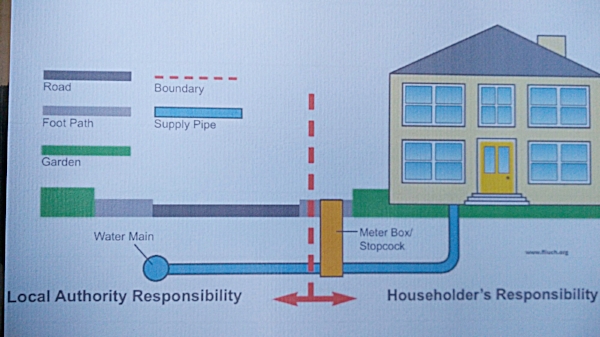
This diagram from a council website is somewhat misleading. The boundary box is called a boundary box because it’s the technical boundary of your dwelling however you also have curtilege which often extends to the centre of the road.

Leak surge after meter installations

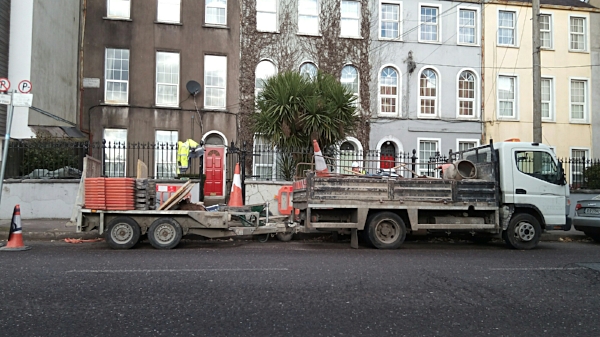
We, along with many others, noticed a surge in leaks AFTER meters were installed. We have eye witness accounts along with video and photo evidence of leaks appearing after meters were installed (mainly water pouring out of boundary boxes). Members of Fliuch witnessed contractors hurriedly filling in holes where water was oozing out. Some of these leaks went unfixed for months, some for over a year.

Keeping with shoddy work

Not only did shoddy work cause leaks it also caused lead to leak into homes as many pipes into homes were lead and were simply cut, with no warning, and had plastic pipes attached to them. No instruction was given to homeowners to flush their system and no follow-up was ever done to test household water for lead.

What about all the boundary box lids that had to be replaced? What about the fact that the plastic lids are not fit for purpose where there are cars passing over them? What about the poor quality concrete used to fill in many boundary boxes that had to be replaced in numerous locations and has still to be replaced in numerous locations?

As for apartment blocks etc, meters were already installed on many mains pipes years ago but were not maintained and allowed to fail. Why were they not maintained? Who was responsible? Why have they not been held to account?

Two of our members live in apartments and one of them has a very bad leak (from the heating system) that the landlord is ignoring as the water seems to be traveling down to the foundation via cavity blocks so it’s not causing any visible problems.

The other lives in a block where there is a tap in the backyard that gets used regularly to wash wheelie bins plus several residents wash their cars almost weekly – so the expert commission is incorrect in their assumptions about people living in apartments not wasting water.


Mainstream Media portrayal of Anti Water Movement

The media would have people believe that the anti water charges movement is simply a ‘populist’ movement full of ignorant, angry, welfare wasters but many of us are educated, hard-working people who have actually put some thought into this.

The word/term populist (populism etc) is being used by the mainstream media in a derogatory way non-stop. It exposes a bias and arrogance that blinds journalists from feeling the pulse of the people and skews their reporting and commenting on what’s really happening in society at large. It’s why the mainstream media failed to predict that Donald Trump would win.

Money  allocated to water infrastructure never spent

The main questions not being asked by the media surround the fact that money was allocated to our water infrastructure but never got spent on it – why not? Where did that money go? Why has there been no audit for so many years? Why has no one been held accountable? Why was funding decreased for several years prior to the introduction of water charges? A common tactic before privatisation.

Fundamentally, no reasonable person should be opposed to metering and charges for wasting water, yes we already pay through direct and indirect taxation for water but we don’t pay for an infinite number of litres per person per day.

Constitutional safeguards needed

We are opposed to enforced metering and charges when there are no safeguards in place to prevent the full-scale commodification and privatisation of our water.

We understand that the Constitution allows for the government to alienate* itself from our natural resources and that any amendment to Article 10 might have implications regarding oil and gas etc. This might not be a bad thing as our State has given away vast amounts of our natural resources already.  In some cases the taxpayer has actually paid companies to exploit our resources.  (*sell or lease)

Refunds and collecting unpaid charges:

*No Consent. No Contract. No Liability.*

If you willingly entered into a contract with Irish Water Ltd you have no real recourse unless you renounce the contract and claim you weren’t in full knowledge of the Terms and Conditions or that the contract was forced on you under threat of penalty and that you were under duress etc.

What the mainstream media aren’t asking is: Will the so-called Conservation Grant be refunded? Will the government demand repayment of that money? Some people who received that money weren’t even liable (if you accepted you were liable) to water charges so they literally got money for nothing. Will the government demand receipts to prove the money was spent on water conservation?

As for those who didn’t pay – Irish Water Ltd is a private limited company – if it wants to pursue unpaid charges it must do it like any other company – via demand notices, debt collection agencies, solicitors, and ultimately through the District Courts. Irish Water Ltd would have to establish in court that the people it’s demanding money from had knowingly, freely and willingly entered into a contract. Under Irish and EU legislation you cannot be forced into a contract against your will. Plus, this is a civil matter not a criminal one so it is not a matter the Gardaí should lawfully be involved in.

Put simply, there is no provision in law for Irish Water Ltd to take people en-masse to court and there is no provision in law for Irish Water Ltd to have the ability to take money from your bank account, wages or welfare. If Irish Water Ltd is reconfigured in some way (as a company) then all claims become void.

We call for an amendment to Article 10 of the Constitution that guarantees the provision of a generous allowance of clean, accessible water with provisions in legislation to grant exemptions (an increase in the allowance) for people with special needs. That same legislation must also take into account wastage caused by leaks and if the government is serious about conservation then it must provide serious finance to fix leaks no matter where they are. Nothing less than a Constitutional guarantee to a generous allowance (an allowance that ensures that no one will pay any extra for their usual/normal usage of water) will stop this movement.

Fliuch

Source:http://www.fliuch.org/in-response-to-water-charges-and-metering/


Inside Politics podcast water charges

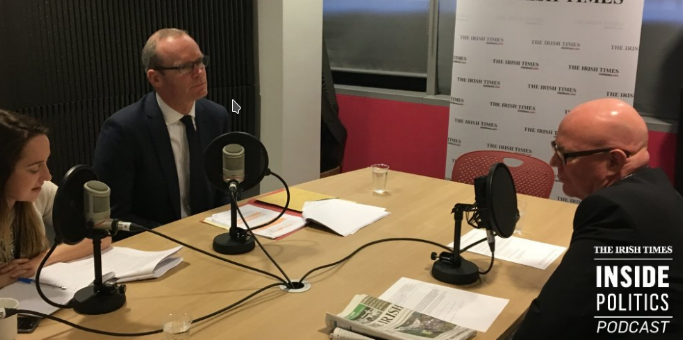
Problem solved... or is it? Simon Coveney and Paul Murphy on water

Will the report of the expert commission on water help bring this vexed issue to a conclusion at long last? Minister Simon Coveney hopes so, but AAA-PBP TD Paul Murphy says "it's not over". They both sat down with Hugh Linehan and Sarah Bardon this morning.