UN backs rights-based approach to small-scale fisheries

UN expert explains goal is to combine cutting edge research with local knowledge, practices

Multinationals competing to meet global demand for seafood must not displace small-scale fisheries, Dr Rebecca Metzner said, and new UN voluntary guidelines aim to promote a sustainable approach. File photograph: Getty Images

Multinationals competing to meet global demand for seafood must not displace small-scale fisheries, Dr Rebecca Metzner said, and new UN voluntary guidelines aim to promote a sustainable approach. File photograph: Getty Images

The strategy of Blue Growth can only be sustainable if it involves and respects the rights of “blue communities” living on coastlines, UN fisheries governance expert Dr Rebecca Metzner has said.

Blue Growth is the long-term strategy to support sustainable growth in the marine and maritime sectors.

Multinationals competing to meet global demand for seafood must not displace small-scale fisheries, Dr Metzner said, and new UN voluntary guidelines aim to promote a sustainable approach.

The guidelines, outlined by Dr Metzner in Galway on Thursday, have been endorsed by the EU, and underpin equitable community access to marine resources as a human right.

The guidelines, endorsed in 2014, aim to promote “responsible fisheries and sustainable social and economic development” for the benefit of current and future generations.

“Small-scale fishing involves about 90 per cent of all such activity the world over, and it is important to protect this sector as a community resource,” said Dr Metzner, who is United Nations chief of the Fisheries and Aquaculture Department, Food and Agriculture Organisation.

At a public meeting in Galway and subsequent visit to the south Galway shoreline, Dr Metzner heard about the specific concerns of the inshore sector and seaweed harvesters.

The seaweed harvesters fear loss of access, following sale of State seaweed company Arramara to Canadian multinational Acadian, which is seeking licenses from Clare to Mayo.

The challenges of climate change and biodiversity loss make protection of local knowledge and associated practices even more important, Dr Metzner said.

She explained that a goal of the UN Food and Agriculture Organisation is to combine modern “cutting edge” research with local knowledge and practices.

Dr Metzner said aquaculture or fish farming was required to “fill the gap” left in demand for seafood worldwide, and managing shared access was a challenge which the guidelines seek to address.

She said she was aware of the recent withdrawal of plans for a 15,000 tonne fish farm in Galway Bay, and said any such plans must involve stakeholders from the outset.

However, stakeholders should work together in advance of any such plans and map where the best shellfish beds are, areas which need specific protection and where conflicts are playing out or can occur, she said.

People who know about fisheries and can facilitate dialogue are crucial, she said, as legal challenges to decisions already taken can waste time and cost money that communities do not have.

Dr Metzner’s visit is hosted by Coastwatch Europe and by NUI Galway (NUIG) geography school and Ryan Institute.

Ms Karin Dubsky of Coastwatch said there was a belief that most small-scale fishers and communities were “not on the radar” of national and regional decision makers.

Dr Kevin Lynch of NUIG said the issues around traditional coastal activities required an integrated approach, and several NUIG post-graduate students are working on a number of projects in this area to influence best practice.

Article by Lorna Siggins Irish Times Feb 25, 2016

Erin Brockovich calls on Irish Water to publish toxin levels

Environmental activist who inspired film calls for trihalomethanes to be listed on bills

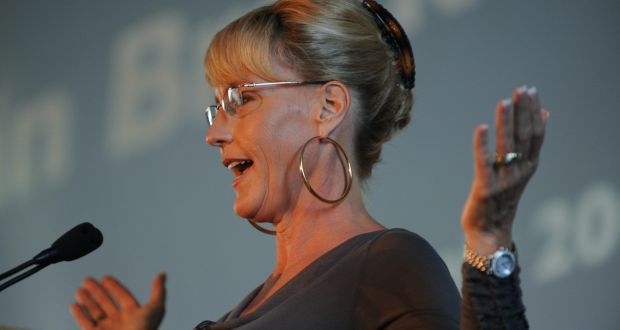
Erin Brockovich speaking at O’Reilly Hall in UCD in 2008. Photograph: Aidan Crawley/ The Irish Times

Erin Brockovich speaking at O’Reilly Hall in UCD in 2008. Photograph: Aidan Crawley/ The Irish Times

Tim O Brien

US environmental campaigner Erin Brockovich has added her voice to calls for Irish Water to publish the levels of water-borne toxins linked to cancers on the bills of some 400,000 affected consumers.

Ms Brockovich, an American legal clerk and environmental activist became a household name after a 1990 film “Erin Brockovich”, starring Julia Roberts. The film detailed her work in exposing Chromium 6 pollution from a gas pipeline in California which was leaking into water supplies.

Following acknowledgement last week by Irish authorities that water borne toxins called trihalomethanes are present in some 79 Irish water supplies, Ms Brockovich added her voice to calls for more prominent information on the problem.

Ms Brockovich and Friends of the Irish Environment want Irish Water to publish trihalomethane levels on consumers’ bills.

Ms Brockovich warned “Irish Cousins” not “to be fooled by this dodge of responsibility and factual sharing of information by your government”.

Last week The Irish Times reported the failure of Friends of the Irish Environment to use the European Commission to force Ireland to inform consumers of these chemical exceedances on their water bills.

In a recent Facebook post Brockovich highlighted the specific danger to pregnant women, writing: “Trihalomethanes are far more dangerous to pregnant women. Studies have demonstrated women exposed to Drinking Water over 80 micrograms/Litre of trihalomethanes expose a greater risk for miscarriage in the first trimester and low birth weight in the second and third trimester... beware of very real “short term” exposure”.

Brockovich linked her comments to a study by the Harvard School of Public Health. This study examined the impact of trihalomethanes on pregnant women exposed to contaminated water based on a cross sectional analysis of 56,513 singleton infants born to residents of Massachusetts during 1990.

The results claimed infants exposure to water containing over 80 micrograms were associated with a 32 gramme reduction in birth weight. It also detailed “slight increases in gestational duration” .

Tony Lowes, a Director of Friends of the Irish Environment said only very limited results for water supplies were published on a website by Irish Water. He said many results were “pending” for more than a year.

‘‘Consumers have the right to know on their bill if their water contains THMs over the recommended limit,” Mr. Lowes said.

An Environmental Protection Agency sponsored conference on trihalomethanes has been announced for June 16th, 2016.

The conference organisers point out that Ireland has the highest reported trihalomethane exceedances across the 27 EU Member States.

The conference website is here.

The film ‘Erin Brockovich’ is being shown on TV3 at 9pm on Friday.


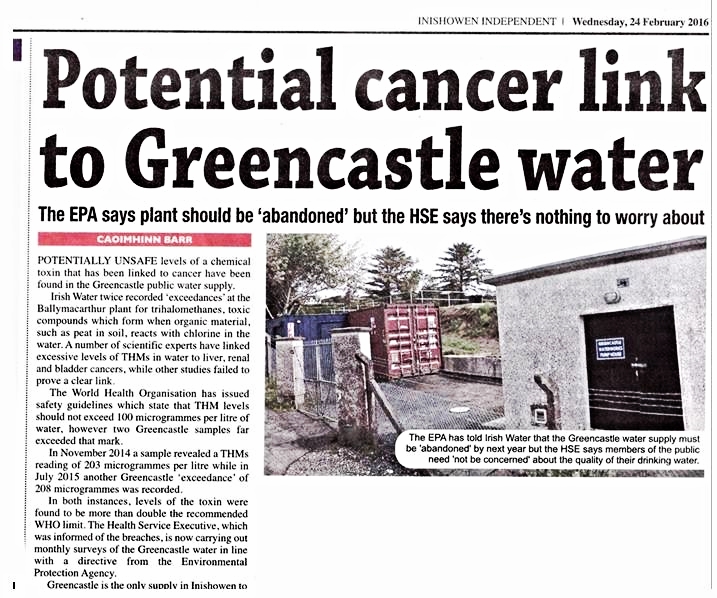
Local Inishowen Newspaper reveals Greencastle drinking water scandal

Well done Inishowen Independent for this article.   It is amazing to see the comments coming from Irish Water andthe HSE, especially.  Anyone would think that the HSE are supposed to exist for our protection.  It seems both outfits are intent on minimising what is evidentally a disgraceful revelation that at least 410,000, including 2000 in the Shrove area, have been consuming trihalomethane in their drinking water, a cancerous causing chemical.  And not only that this has been happening for years.  Could we have an investigation please?  Only this will give us some reassurance.

The response from Cllr Farren is absolutely weak .  Instead of representing pathetic comments from Irish Water representatives he should at least call for an immediate investigation and demand, without equivocation, the closure of this outdated plant at Ballymacarthur, Greencastle. 

However, it must be emphasised there is a total blank when it comes to responses to this outrage from all local political representatives.