
Electricity bills to jump as report slams bonuses

eirgrid.jpg

Consumers and businesses are facing hikes in electricity charges at a time when the operators of the network are getting bonuses of up to 15 per cent.

The two companies responsible for the country’s electricity network are in line for spending increases of €1.8 billion over the next five years, bringing their total budgets to €5.2 billion.

This will increase the average electricity bill for a family by at least 5 per cent over the next five years. Businesses can expect similar increases in their electricity costs.

A significant proportion of the increases in network charges will go to fund new power lines being planned by the state-owned grid operator Eirgrid. Some €500 million, meanwhile, will be used to fund the rollout of smart electricity meters to two million households by ESB Networks, which maintains the network.

However, a report prepared for the Commission for Energy Regulation by consultants has criticised the bonus payments made to staff at Eirgrid. The consultants, Jacobs, found that Eirgrid had consistently paid bonuses of up to 15 per cent to its staff during the economic recession over the past five years.

The report said that it would have expected the payments to vary with “some achieving their targets and others failing”. But Eirgrid did not give any precise details of what the staff had done to earn this “performance-related pay”, and the report found that only 14 per cent of the biggest electricity projects were delivered on time over the past five years.

The Jacobs report states that between €6 million and €7 million of the money Eirgrid has paid out in bonuses was “inefficient”, and that their cost should not be passed on to electricity customers.

It showed that the highest individual bonus payments were to Eirgrid managers, who got 15.4 per cent in 2012. These managers are getting slightly lower performance-related payments of 14.1 per cent this year. There are also performance related payments for Eirgrid professionals (13.2 per cent), directors (10.2 per cent), and those in graduate or support grades(12.6 per cent). The average bonus payment this year is 13.1 per cent.

Eirgrid has applied to the regulator to continue paying bonus payments of up to 15 per cent to staff for the next five years. It said it did not make the payments to all staff, and that it was keeping all aspects of its business under review, including staff wages, “to ensure they are competitive and in line with market rates”.

The energy regulator is proposing annual increases in the two main electricity charges which fund Eirgrid and ESB Networks. Electricity distribution charges are paid to ESB Networks and account for 25 per cent of customers’ bills.

The proposed rises of 1.9 per cent per year up to 2020 are on top of inflation. Economist Stephen Kinsella has calculated that this equates to an 18 per cent increase in distribution charges over the next five years. He said this alone will increase the average electricity bill by almost 5 per cent over the period.

“Oil prices are collapsing and commodity prices are in the toilet. But the operators are hoovering up a bigger increase in the recovery for themselves,” he said.

The Commission for Energy Regulation has also proposed that the electricity transmission charges, which are paid to Eirgrid, will rise by 2.5 per cent per year up to 2020.

These charges have a smaller impact on households because they only account for 5 per cent of customers bills. The regulator has not released any figures on what the overall rise in electricity charges would cost consumers over the next five years.

A spokesman said the proposed impact this year would be a 1 per cent rise in electricity bills – which would add around €10 to an annual household bill.

“The actual outcome for customer prices depends, among other factors, on international fuel and related generation costs, which are currently circa 50 per cent of the overall cost of electricity to customers,” he said.

Eirgrid’s staffing costs went €16 million over budget over the past five years, with its 278 staff now paid an average salary of €97,000 each. It argued that it was using a “holistic approach” by increasing staff numbers and reducing the hiring of outside contractors.

It has to work with ESB Networks, which has 3,145 staff, to maintain the electricity network. They get an average salary of €80,000 and bonuses of up to 8 per cent. But the Jacobs report said there were signs that targets were “sufficiently robust”.

ESB Networks failed to deliver €10 million of efficiency savings that it had promised and is consistently missing its targets for maintaining the electricity network. The consultants said this consistent underperformance may lead to “an ongoing degradation of the health of the assets”.

ESB Networks said it was inappropriate to comment because the public consultation on the electricity charges was still ongoing. “We will participate in that consultation and look forward to conclusion of the process,” a spokesman said.

Smart Meters What Are They And Why We Should Be Worried About Them!

Read all about 'Smart Meters' at www.fliuch.org/smart-meters.


The Grant

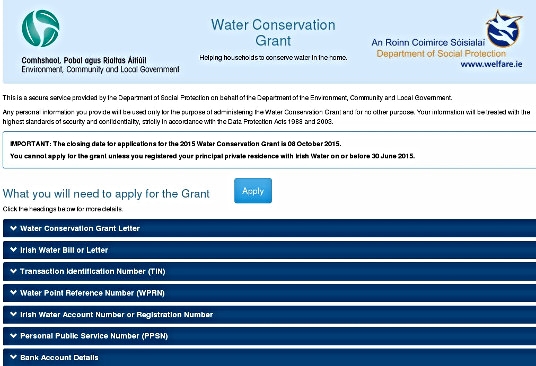
As things stand you must register as a customer of Irish Water Ltd to qualify for the grant.

You must then provide your PPSN and bank account details to the company working on behalf of the Department of Social Protection who will then cross check with Irish Water Ltd that you have indeed registered at which point you qualify for the grant.

You do not have to pay the bill to get the grant.

However, bear in mind you have now knowingly entered into a contract with Irish Water Ltd.

The legislation is already in place to make paying the bill mandatory to qualify for the grant.

Getting the grant without paying applies this year only (2015-2016).

The Environment (Miscellaneous Provisions) Act 2015 has a section dealing with water charges, it contains some very harsh measures for non-payment and provides for linking payment of the grant to payment of the bill.


Irish Water grants Coalition partners a reason to fall out

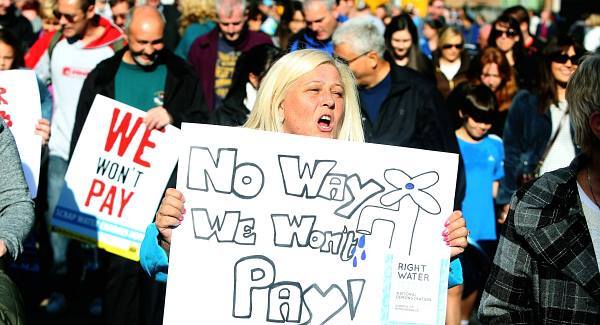
For the opposition, Irish Water is the gift that keeps on giving — even more so when that gift involves an internal Government row about giving €100 to people refusing to pay their charges.

Over the past 24 hours Irish Water has caused yet more havoc for the Coalition after reports that the “water conservation” grant — seen by some as little more than a bribe — would only be given to people paying their bills.

The suggestion was quickly shot down by Environment Minister Alan Kelly, Tánaiste Joan Burton, Transport Minister Paschal Donohue, and others, but the controversy has at the very least given the opposition two fresh areas in which to attack the Government in the final months before a general election.

Despite the plan being denied by senior members of the Cabinet, it is clear that Labour and a section of Fine Gael backbenchers are no longer seeing eye-to-eye on a key matter of policy.

And when, depending on who you listen to, that policy relates to either wasting taxpayers’ money on a grant given to people refusing to pay water charges or taking money away from struggling would-be voters, it is yet another no-win situation for the Coalition and an open goal for an opposition constantly waiting to pounce.

Under the current water conservation grant, anyone registered with Irish Water before the end of June is entitled to receive a €100 fee to help them conserve water.

The fund was introduced last autumn during the first of the Coalition’s multiple U-turns on Irish Water as it attempted to convince people to sign up while smoothing over Phil Hogan’s less-than-subtle approach.

Over the subsequent months, Labour and Fine Gael were at pains to stress the €100 was not a bribe but rather an incentive to use water more responsibly — an explanation that led on to the then-unmade Eurostat decision on whether Irish Water is a private firm.

After the EU group’s ruling that Irish Water must remain on the exchequer’s books, and its swipe at the grant in particular, it appears a number of Government TDs have now given up on the argument — this time with one eye on the safety of their own Dáil seats.

Fine Gael TDs Eoghan Murphy, Paul Connaughton, Brendan Griffin, and Ray Butler, along with Senator Catherine Noone, have all raised concerns and “deep unease” over people who are registered with Irish Water but not paying bills receiving the fund.

That deep unease undoubtedly relates to would-be Fine Gael voters who are more likely to pay their bills, as most members of the public would be more than happy to receive €100 for no reason, more than the wider population itself.

It is no surprise then, that on the same evening as the comments were made, media leaks suggested the grant — for which people are being told how to apply from today — will soon be limited to billpayers only, following a Fine Gael pushback.

The argument, while controversial, has a certain logic if the Government is willing to finally admit the grant is little more than a bribe to pay Irish Water bills.

However, it provoked a sharp denial from Labour ministers who insisted no changes are planned, prompting Fine Gael to follow suit.

[Saying 'no changes are planned' is not a lie because no changes are needed. Legislation already exists to connect the paying of bills as a condition of receiving the bribe – in the form of the Environment (Miscellaneous Provisions) Act 2015 (water charges section) – Fliuch]

Labour headquarters was adamant the first it knew of any proposed changes was through the media. One figure questioned “if it was a co-ordinated attempt by Fine Gael”, although its Coalition colleague rejected this, saying it is only a matter for the Department of the Environment.

Whether the latest Irish Water controversy is about nervous backbenchers speaking out of turn, a genuine dispute within the Coalition over the €100 grant, or a hidden new plan slipping out into the open, it is not good news for Government.

While Fianna Fáil and Sinn Féin were reluctant to clarify whether they would take away the money from families or be happy to give it to people refusing to pay the charges — preferring to claim the Government does not know where it stands — the problem currently lies solely with the Coalition.

But then, when it comes to Irish Water, doesn’t it always?