Turkish Court Shuts Down 50 Turbines: Yaylaköy Residents Delighted at 1st Chance to Sleep in Years

See below for closer to home article on wind turbines

One of the myths pedalled by Australia’s self-appointed wind farm noise, sleep and health ‘expert’ (a former tobacco advertising guru) is that the known and obvious adverse health impacts from incessant turbine generated low-frequency noise and infrasound are a cooked-up “phenomenon”, exclusive to the English speaking world. Trouble with that little tale is that’s been scotched by the Danes:

Turkish Court Cans 50 Giant Fans so residents can sleep, at long last.

Turkish Court Cans 50 Giant Fans so residents can sleep, at long last.

Vestas’ Danish Victims Lay Out the FACTS
Denmark Calls Halt to More Wind Farm Harm

And the Germans:
German Medicos Demand Moratorium on New Wind Farms

And the Tawainese:
Winning Taiwanese Hearts and Minds?

And, now the Turks. As this article lays out – in terms so simple, that even tobacco advertising gurus should be capable of understanding them.
50 operating wind turbines stopped by the court!
BurGün
18 May 2015

The Administrative Court in Ankara has ruled that fifty operating wind turbines in Karaburun be stopped. The locals of Yaylaköy, Karaburun are delighted with the court decision. It is 20 days since the wind turbines stopped working.

From the beginning of the struggle to protect their village from the adverse affects from the Wind Power Plants that are spreading all over the peninsula, the local people have finally received good news.

The Administrative Court, ruled in April that even if fifty wind turbines are already operating, the activities have to be halted since the environmental damage is irreversible. First an EIA report will have to be issued. The wind turbine company’s request to continue to run their turbines meanwhile, was also denied by the court.

THE FIRST DECISION

The lawyer Cem Altiparmak said the decision would be a first in the country. Mr. Altiparmak states that there are very few court cases related to renewable energy.

In this area the law is insufficient, there are no precedents, so we have to live it to get experience. “A number of license revocation proceedings have started in our country. Our court ruling is one of the first and will have an impact on up-coming cases.

What has happened?

İzmir Governorship Provincial Directorate of Environment and Urban Development, had issued a “EIA Not Required” to install 166 MW in the Karaburun Peninsula.

8 years later when EMRA issued a new license for another 50 turbines to the same company leaning on the same “EIA Not Required” document, the residents of Yaylaköy and the environmental movement Karaburun City Council sued EMRA – The Energy Market Regulatory Authority.

The court ruled that this is against the law and if allowed to operate the damages will irreversible therefore all operations have to be stopped until an EIA investigation has been performed.

The court decision has given hope to the local people as well as other people in Cesme, Bodrum, Datca and Urla where wind turbines projects are being planned without any public consultation. All these projects have been issued with an EIA Not Required”.

Hopefully this Wind turbine project will not be able to operate again and for the first time in years the people in Yaylaköy are able to sleep comfortably and we will continue to work for that, says one man from the village.

The value of “a good night’s sleep” is the same in any language

The value of “a good night’s sleep” is the same in any language

Original Article stopthesethings.com


Closer to Home Recent Wind Turbines News

The Independent reported on 25 May 2015 that the Labour Party parliamentary party will this week debate proposals to introduce new restrictions on the development of wind turbines close to people’s homes. Apparently Labour TDs and senators are demanding changes in “set-back distances” and the introduction of a cap on the size of turbines.

“Environment Minister Alan Kelly is understood to be considering plans to increase the distance required between homes and turbines from 500m to 700m.”

There are two things very wrong with this statement. Firstly, 200 extra metres will not make any difference at all to the nearby residents’ health and quality of life. Secondly, the debate on setback distances conveniently avoids the more important debate as to whether we need wind farms at all, given the dramatic over-supply of these monsters already, and the undue emphasis placed on wind-energy to the detriment of other renewable energy sources.

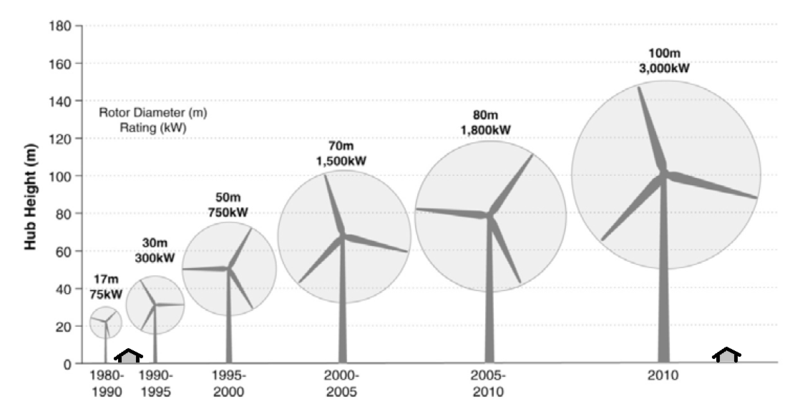
Minister Kelly, enough of this nonsense.  When the 2006 Guidelines were published, recommending a setback distance of 500m, wind turbine heights were on average 54m tall.  The turbines being used in Ireland are  at least 3.5 times as high, some 185m tall.

This graphic from Harvard University shows how wind turbines have grown over the years. That graphic is now five years out of date, with industrial turbines growing even larger in the interim period – the maximum height shown here of 100m has almost doubled in the last five years.

Accordingly, at the moment we should be talking about a minimum set-back distance of 1.5 km to obviate the health dangers of noise. The proposed 700 m is still less than half this minimum distance. When taking into account the flicker effect, a minimum set-back distance of 3.00 km seems reasonable.

When one considers how wind turbines are continuously increasing in size and power, it might be prudent to talk about a distance of 5.00 km? Given how long it takes to amend these guidelines, perhaps we should plan for the future? Or an even better idea, why not stop building them?

The Labour Party wonders why it has zero-credibility with the Irish public.  When they pull stunts like this, I am surprised at their surprise.

The Law is my Oyster article


Bank's Dealt Massive Blow with High Court Judgement: Home owners celebrate

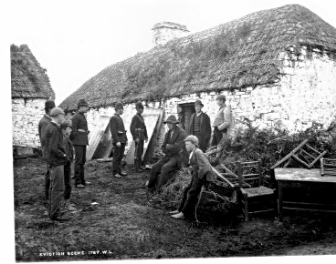
The National Land League Of Ireland click photo

The National Land League Of Ireland click photo

The National Land League Celebrate May 20, 2015

(This article was updated one day after publication: additions at end of article)

Circuit Court Con Job

There’s been a con going on in our Circuit Courts for the last few years. It’s a con that the courts, the legal profession and the banks have all been in on together and the veracity of the claim that it has been a con emerged today from the High Courts and a ruling by Ms. Justice Murphy.

Over the years, in an effort at putting efficiency before the rules of the court, the banks have been applying to the Circuit Courts for possession Orders on family homes. The Circuit Court rules are clear that only matters involving less than €75,000 can be heard in the Circuit Court. Now we know most houses are still worth more than €75,000 and to circumvent the rule the banks have, with the complicity of court Registrar’s and the legal industry, been allowing family home possession applications into the Circuit Courts claiming that the rateable value of the property is within the rules as, they claim, the rateable value of the property is under €253 odd. Today’s ruling by Ms. Justice Murphy simply blows the rateable value argument out of the water.

A home does not have a rateable value and has not had a rateable value since the early 1970s. Activists have been arguing this around the country but their arguments have been falling on deaf ears until now. Today in the High Court a jubilant appellant, appealing an Order of Possession on her home from the Circuit Court, and with the advice, support and backing of the Hub-Ireland, broke the mould. In her judgement Ms. Justice Murphy said…

“The Plaintiff maintained that it had invoked and was entitled to the provisions of the valuation act and a letter issued by the Valuations office was sufficient: both these assertions are manifestly unfounded on the evidence…….it appears to the Court on Evidence that the Plaintiff have devised and used an ad hoc non-statutory process which is devoid of legal effect, for the purpose of persuading the Circuit Court that it has jurisdiction which it does not in fact enjoy”.

What are the implications?

So what are the implications of today’s ruling? Firstly, we can expect that banks will be left with no choice but to withdraw their current applications in the Circuit Courts for possession of family homes. If you are in court over the next while demand a strike out. If an Order has been made on your home, it can be considered null and void and as having never existed. Contact your local Sheriff over the next few days and ask what the ruling means for you, meanwhile the various anti-eviction groups around the country will be forwarding the judgement to all Registrar’s and Sheriff’s and requesting their current position in light of the ruling.

You can contact the National Land League on the number below. All calls are strictly confidential and are treated with understanding and kindness. Together we are strong.

We in the National Land League and other groups are not naïve however and we know that it will be the impulse and attitude of the banks, their legal partners and indeed the courts to press on regardless. We must not allow this to happen and the ruling by Ms. Justice Murphy must be enforced primarily by all of the lay-litigants across the country that up until now have been trampled upon.

On a final note, if you are made aware of any attempts to circumvent this ruling within the courts please contact the National Land League, the Hub-Ireland and other groups to let us know. We expect arguments to be made by “the other side” that they are using the Poor Law Valuation (Griffith’s valuation) to enter the Circuit Court. This has been tried before. The PLV was deemed unconstitutional by the High Court in 1981 and this was upheld on Appeal to the Supreme Court. Once more, congratulations to The Hub-Ireland on a ground-shaking result today.

N.B.... update : A deeper analysis of the "Bank of Ireland Mortgage Bank  -and- Laura Finnegan and Christopher Ward" case within 24 hours of it's reading from the bench reveals a number of exclusions within this judgement and accordingly the author of this article  adds the following...

To clarify some details about yesterday's great win in the High Court regarding applications to the Circuit Court for possession Orders on family homes and the jurisdiction level of 75k. Having read the Judgement in its entirety a number of times now, the ruling has most significance for those who took out their mortgages between 2001 and 2009, and in which the bank's initiated proceedings prior to the 31st of July 2013 (the date that the Land and Conveyancing Law Reform Amendment Act 2013 took effect).

For those whom the bank have initiated proceedings after the 31/8/13, the ruling is not so clear in that the 2013 Amendment to the LCLRA 2009 changed the law by facilitating banks to initiate home possession cases in the circuit courts despite there being no rateable valuation (the amendment claims to enact a provision from the LCLRA 2009 retrospectively to include mortgages pre-2009).

Where the bank has stated that they have relied on a rateable valuation post 31/8/13 it is strong argument to say that they still cannot rely on this (possibly 50% of current cases). For those whom the bank have initiated proceedings post the 31/8/13, and in which the bank has not claimed to rely on the rateable value for Circuit Court jurisdiction, do not be downhearted as there are a number of possible avenues to push this over the line for you too.

The 2013 amendment is facing a constitutional challenge as we speak because it is essentially retrospective law which is an abomination to the basic principles of law. It would also appear where the loan was an equity release on a property already paid for and not for the purpose of buying a domestic dwelling, and in which the home was used as security and not a "housing loan mortgage" (this is the type of loan the LCLRA 2009 clause refers to), and this is where most older people have been trapped, the case must be heard in the High Court

Original Article


May 25, 2015 Gardai Brutality in Castlebar Circuit Court

Members of the Mayo branch of the National Land League of Ireland, assisted and supported by Integrity Ireland, gathered at Castlebar Circuit Court today (Monday 25th May 2015) to request clarity in relation to Ms. Murphy's recent judgment in the High Court regarding rateable value.

A spokeperson for Integrity Ireland said " Mr Barrett only wanted to ask a legitimate question which he had lodged with the Court in advance, but Mayo County Registrar Fintan Murphy point-blank refused to hear his question. This is a violation of Article 40 of the Constitution as well as a blatant breach of Court Rules. Mr Murphy has been reported (again) to Gardai for inciting public unrest, and Sgt Hanley has also been reported for seven physical assaults including three which caused actual bodily harm.. The full text of the criminal complaint will be lodged here in due course."


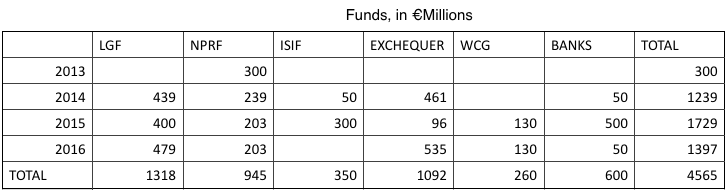
The Many Fundings Of Irish Water

It has become more and more difficult to understand where Irish Water funds come from, and the government has certainly not helped, merging funds into one another, diverting investments…


€6.5bn earmarked so far, and counting

LGF - Local Government FundNPRF - National Pension Reserve FundISIF - Irish Strategic Investment FundWCG - Water Conservation Grant

LGF - Local Government Fund
NPRF - National Pension Reserve Fund
ISIF - Irish Strategic Investment Fund
WCG - Water Conservation Grant


1-Local Government Fund (LGF )

The LGF was set up to fund local authorities. You pay your motor tax, it gets pooled into a central fund and is then redistributed for what it is intended to address, eg roads. But the government doesn’t see it like that.

The LGF fund receives €1bn per year from motor tax, and since 2014 it also receives the newly introduced Local Property Tax (LPT), to the tune of €500m per year. Also supposed to be redistributed to Local Authorities.

€1.3bn of LGF funds will go to Irish Water by 2016:
(
source)


2-National Pension Reserve Fund (NPRF)

Irish Water had accrued €14m debt already late last year on its borrowings from the National Pension Reserve Fund.

The debt was confirmed by Finance Minister Michael Noonan after a Dáil parliamentary question revealed the original €250m loan had risen to €300m.

Responding to questions from the Fianna Fáil environment spokesman Barry Cowen, Mr Noonan said the money was provided to help Irish Water pay for meters being installed from 2015 to 2019.

He said the deal was made in July 2013, when a €250m “bridging loan facility” was handed over by the reserve fund.

The money, which rose to €300m after a further request this month, was paid over in two parts, at the end of last year and during summer 2014.

It is due to be fully repaid by next September.

If it is due to be paid back by September, I wonder why the same fund is being plundered again in 2015/2016:

€945m of NPRF funds will go to Irish Water by 2016:
(
source)


3-Irish Strategic Investment Fund (ISIF )

Interestingly, the ISIF will be merged with the NPRF and replace it.

As much as LPT was being merged with the LGF, once again funds are shuffled and tricks are pulled, making it difficult to understand if the numbers cited in different newspapers took this into account or not.

Regardless, and until this has been cleared, the numbers cited in those articles do not tally up, so I’ve kept them separate:

The utility company is the biggest beneficiary of ISIF money to date, having secured a €300m capital investment — more than a fifth of the total amount committed from the fund.

€300m of ISIF funds will go to Irish Water by 2016 (source)


4-Exchequer

Once again, this could be another trick by the government. It is easy to say that ISIF and LGF funds are part of the Exchequer remit, but once again figures provided in the media made no distinction whatsoever and did not add up when compared to other funds.

€1.1bn of Exchequer funds will go to Irish Water by 2016:
(
source)(source)


5-Water Conservation Grant (WCG)

This program is set to cost €130m a year, but there is no indication that this will be drawn from existing funds featured in the table.
€260m need to be spent to finance WCG until 2016
(
source)


6-Banks

Despite all this generosity and ingenuity from the government to make it as murky as possible, Irish Water also asked the banks for help.

50m overdraft facility at Bank Of Ireland, €100m loan from Ulster Bank,
€450m from others (AIB, Barclays, BNP Paribas, BOI, Danske, HSBC, Ulster, Royal Bank of Scotland and Royal Bank of Canada)

€600m of private funds will go to Irish Water by 2016.
(
source)


7-Is there more?

Of course there is.

Irish Water now also collect Commercial Rates from Local Authorities, that’s another €250m a year.
€750m of Commercial Rates will go to Irish Water by 2016.

The table at the top of this article is only for period 2013–2016, but tens of millions had already been spent in 2012:

-Hogan knew of €40m Irish Water consultancy allocation in 2012
- “speaking to reporters on 15 January, Hogan said he wasn’t aware of the specifics of the spend on external services, noting that he “certainly knew” about the total €180 million cost of setting up the company” (link)

€200m were spent in 2012 setting it up.
NB: it is unclear if these costs were part of the NPRF €300m loan in 2013 featured in the table above. According to this article from 2012:
€450 million would be given to Irish Water from the National Pension Reserve Fund, which would be passed on to customers through a standing charge over 20 years.

And the financing involves hundreds of other millions:

-Irish Water will also be spared €60m in rates charges that other utilities will have to pay
-On top of this up to €40m extra will have to be paid out to homes that are not customers of Irish Water
-Siteserv, the business purchased by Denis O’Brien from IBRC, with a write off of €110 million, was subsequently awarded the water meter contract.
-Energy watchdog to pay consultants €900k for advice on Irish Water
-State underwrites new €100m borrowing by Irish Water
Total:        €1.2bn extra funds in exemptions and for CER

And in another bewildering statement, the IMF has now hinted that failing the Euro test would not put the utility in jeopardy, instead they would throw another €550m at it! And to fail it is.

Do the Maths

By 2016:
1-€1.3bn of LGF funds
2-€945m of NPRF funds
3-€300m of ISIF funds
4-€1.1bn of Exchequer funds
5-€260m need to be spent to finance WCG
6-€600m of private funds
7-€750m of Commercial Rates
8-€1.2bn extra funds in exemptions and for CER


TOTAL: €6.5 Billion

And that’s before the €550m the IMF suggested we throw at it again if it fails the EU test.