
Energy back in local hands

Photo credits: Riccardo Annandale

Some examples in Europe show that cities running their own energy company can lower the energy bill for citizens

Across Europe, town and city councils are becoming increasingly interested in energy decentralisation, i.e. in producing power closer to where it is consumed.

Those municipalities that have already experienced this say the model is one of the best ways of fighting pollution and reducing energy costs for citizens. Heidelberg is one such city in Germany, with its long-running energy company.

The city-owned company is responsible for managing gas, heating, and the water and sewage systems. “The most important issue was that we started our action plan with all the population behind us”, states mayor Eckart Würzner. “We have a general strategy to be a city free of fossil fuels by 2050. This is extremely challenging since we are a growing city and therefore we have to switch to renewables in very little time,” he points out.

The Municipalityhas developed a new urban area, Bahnstadt, that is 100 % CO2 free. “The buildings are very energy efficient and the resources used to serve this area are 100 % renewable. We have noticed that the energy demand of the flats’ owners has fallen dramatically,” adds the mayor of Heidelberg. All the buildings in Bahnstadt are constructed to ‘passive house’ standards. This construction concept allows the inhabitants to cut their energy consumption for heating by 80% compared to normal houses.

Energy is generally inexpensive in Sweden since there is a long tradition of cities supplying citizens with affordable home-grown power. In addition, prices are kept low by the large choice of energy companies – around 300 – on the market today.

Växjö is no exception and governs its energy policy and resources independently. “We own our biomass plant, where we produce electricity, heating and cooling, and for 20 years we have been using only bio-energy. Actually the entire city is heated with bio-energy”, says mayor Bo Frank. 

He adds that the city also owns facilities for biogas production. “Each citizen is more or less required to put all organic waste in a separate container. We use that organic waste to produce biogas for all public transport”, explains Frank. The city promotes public transport to limit the number of cars in the city centre. “We encourage people and companies to buy electric cars. All cars owned by the Municipality are environmentally-friendly”, states Frank.

In France, the city of Grenoble has been able to gain the trust of its citizens thanks to its 100 year-old energy company. Private businesses sell electricity to under 20% of the population.

“Private stakeholders are only interested in the financial aspect, whereas local energy suppliers also take into account the social, environmental and spatial dimensions of cities”, says deputy mayor Vincent Fristot. He adds that the Municipality can offer specific support to people who are unable to pay their electricity bills. It involves allowing citizens to pay in instalments or to fit home devices with low-power consumption.

Besides the social benefits granted to citizens, the local energy supplier in Grenoble has invested in renewable facilities, such as wind turbines and photovoltaic panels. “It was very important for us to be able to supply green energy at the best possible price, which can compete with private energy companies”, emphasises Fristot.

Cat Hobbs, director of We Own It, a British campaigning organisation, located in Oxford, agree on this approach: “It is difficult to have control over energy policy when the company is private. They do what they like; therefore, for those who want to produce renewable energy, it would be much easier to set up new companies, with public ownership”.

More and more communities in Europe are pondering a return to public management of power and of other important assets such as water. The new trend is known as remunicipalisation.

In other words, energy back in local hands.

Source: Fliuch.org


Army Corps will close anti-DAPL protest camp at Standing Rock by Dec. 5

Excellent interview with Ward Churchill

The US Army Corps of Engineers announced it will close the portion of federal land on which water protectors are camping in North Dakota by December 5, to protect the public amid violent confrontations between protesters and law enforcement.

The Army Corps of Engineers said it is “closing the portion of the Corps-managed federal property north of the Cannonball River to all public use and access effective December 5, 2016,” according to a statement tweeted by the Young Turks' Jordan Chariton.

The notice comes a week after 26 people were injured and taken to hospital during classes at the pipeline site last Sunday and more than 200 were reportedly treated for hypothermia after Morton County Sheriff’s Department deployed water cannon in below-freezing temperatures.

Since the Spring, protesters have been standing in opposition the $3.7 billion Dakota Access Pipeline by setting up camps and blocking roads in North Dakota to block the completion of the pipeline.  

Among the injured was Sophia Wilansky, who nearly lost her arm when a law enforcement officer threw a grenade at her that exploded.
The North Dakota Highway Patrol said law enforcement officers were not responsible for Wilansky’s injury.

“We are aware of the information about the woman on social media who has claimed she sustained injuries to her arm due to law enforcement tactics. The injuries sustained are inconsistent with any resources utilized by law enforcement and are not a direct result of any tools or weapons used by law enforcement,” according to North Dakota Highway Patrol Lieutenant Tom Iverson. “This incident remains under investigation by the North Dakota BCI and ATF. Additional details will be released as the investigation progresses.”

Another woman, Vanessa Dundon, an Apache woman, was injured during the confrontation on November 20 at the Backwater Bridge when she was shot in the eye with a tear gas canister by the Sheriff’sDepartment. She suffered a detached retina and needs surgery to ensure her vision according to a GoFundMe appeal set up for her medical fund.

Source: RT, Nov 25, 2016


Irish Water Ltd - Twenty-first century plunder of Ireland

This article  is based on a powerful speech by Mick Wallace, TD in Dáil Éireann, Nov. 9, 2016,  debating 'Thirty Five Amendment to the Constitution (Water in Public Ownership) Bill.'  

Buncrana Together is publishing it below, verbatim,  since we believe it is one of the most important speeches that we have heard.  

It is an article that we intended to do as a follow up to  'The battle of Irish Water, another reason to heed protesters'.  However, we did not get around to writing it.  The subject matter  is complex.  It is a tangled web of interconnecting elements encompassing multi-national corporations,  vast amounts of money, Government collusion and European bureaucracy.  It is a story of government agencies and public bodies,  willingly or unwittingly, succumbing to the guile of international and national lobbying in the quest for power and wealth.  It is a story that begs more investigation by impartial  experienced journalists.  

 In short it is a story of corporate imperialism and greed.

In this centenary year of the 1916 Easter Rising, Mr Wallace's words are poignant and somewhat ironic.   On the one hand it is a year  to celebrate and honour the men and women of 1916 and all those who fought against and suffered oppression, plunder and conquest.  However, one hundred years later we have the situation where our country is being plundered by multinational corporations aided by the Irish Government, carving up our natural resources and oppressing the majority of Irish people.  

The importance of getting rid of the Irish Water Ltd quango can not be understated.  Irish Water is the nucleus of this corporate takeover.  We would like to add RPS to Mr Wallace's list, This is a company that is at the heart of the Irish malaise.  RPS describes itself as 'Ireland’s leading planning, design, engineering, environmental and communications services consultancy'. 

This is no small boast.  In fact it is true.  For the past thirty years this company has been working hard to get into a position where it is the leading adviser to the Government in Ireland. It consults and lobbies every planning authority in Ireland.  It has influence over the country's architects and engineers, technical colleges and universities, education in general. 

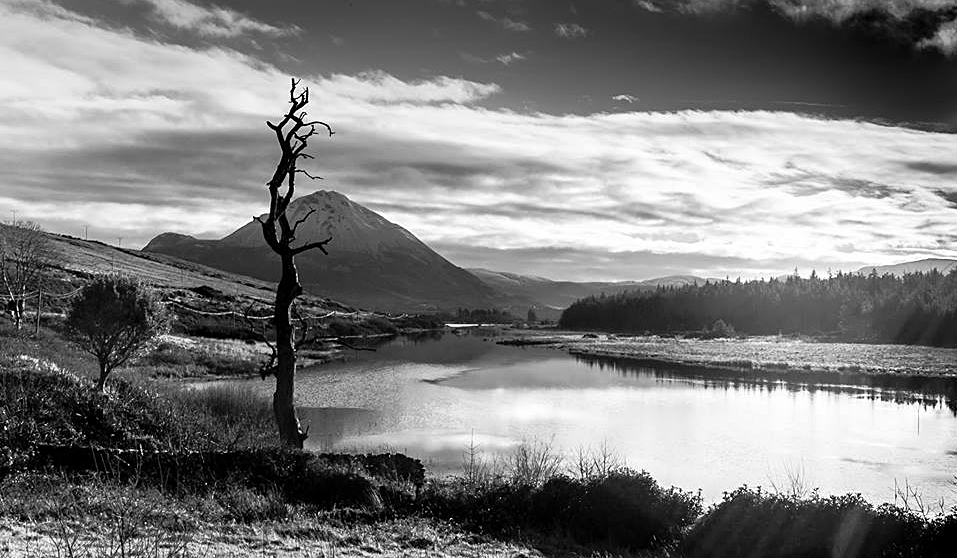
Photo: Jennifer Sayers: Errigal, Co Donegal, Ireland

Unless we get rid of Irish Water, it might as well be privatised

Deputy Wallace:  "Like most people in Ireland, I do not think the water service should be privatised, but, sadly, unless we get rid of Irish Water, it might as well be privatised because that is where we are. For want of a better term, Irish Water is another version of the HSE and literally outsourcing just about anything it has on its table. It is carving up the country.

We have Aecom in the Dublin area, EPS in the Cork area, Veolia in Kilkenny and Glan Agua in Galway. Between the four of them, they are literally taking over water provision in Ireland.                                

 They are designing, constructing and operating facilities. Of course, the money is to be made in operating facilities, which I am sure is not news to the Minister. If people are paying through the Government, it will cost a fortune now that we are allowing Irish Water, a version of the HSE, to arrange how water and wastewater services are organised in Ireland.  There are huge problems.

Some of the companies are incredibly big and will do what they like. I will mention one of them. Veolia has just won a 20-year design, build and operate contract with Irish Water which includes an €18.4 million upgrade of wastewater infrastructure in County Donegal.  In May it won a 27-month design and build contract in Cavan. The water treatment plant in Athy, County Kildare is operated by it under a 20-year design, build and operate contract.  It was the operator of Ireland's largest biomass power plant in Killala, County Mayo.  It was to meet the total biomass fuel requirement in the vicinity, with biomass to be brought from the United States, landed at Dublin Port and transported by road across the country. The project has run into the sand because it does not make any sense.

I would like to see some transparency on how the whole thing was set up. Was there a tender process? It was a gift to foreign corporations from the State which is about to produce dirty energy, the production of which will be subsidised by the people of Ireland. It was to be expensive. US investors were guaranteed a price well above the level in the wholesale market available to unsubsidised generators.

What a disaster we have have at Ringsend. Celtic Anglian Water, a subsidiary of Anglian Water in the United Kingdom, is being allowed to print money because of its contracts and seemingly Irish Water can do nothing about it. Celtic Anglian Water has Irish Water over a barrel and can charge whatever it likes. There is mayhem. The Minister should take a close look at what is happening in Ringsend. I would like him to come back and tell us that everything is grand because I have information from inside the industry that things are far from it. There are huge problems.

Before Irish Water was established, we had the local authorities taking the same route. What Irish Water amounts to is a red tape version of what we had in place around the countryside with several layers on top. Bureaucracy has flourished under Irish Water which has increased the amount of red tape no end. The Minister should tell me I am wrong. Is Irish Water getting huge companies to design, build and operate plants and giving them 20 to 25-year contracts to complete the project?  

We are giving them powers that will be almost uncontrollable in the years to come similar to the powers Celtic Anglian Water has in Ringsend.

 Veolia which is not even the biggest in the country but which will probably become the biggest because it will  gobble up some of the others in the near future is involved in the energy and transport sectors.  

It had to sell off its transport operation in Israel where it was introducing transport measures in the Occupied Territories.  Palestinians, however, were not even allowed to use the transport system.  Veolia had received so much bad publicity that it had to pull out of it. It is all over the shop in the United States where it has been thrown out of several cities for bad practice and introducing cost-cutting measures at the cost of quality and because of health concerns. Somebody in the United States said recently that if one wanted to describe what Veolia got up to, it would come in, rape one's water company and leave with money bags. It is to take over water services in this country unless we get rid of Irish Water and the Government takes a direct role in it. Inserting this measure in the Constitution will be a waste of time if we go down this route."


Source: oireachtasdebates.orieachtas.ie