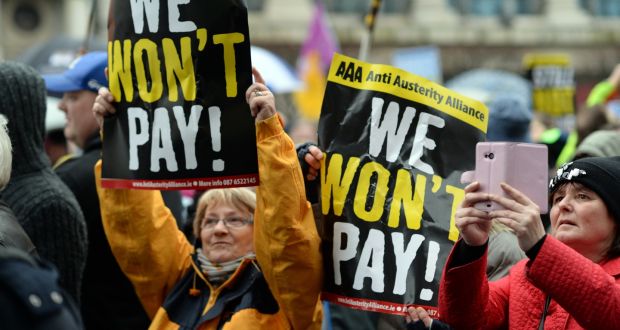
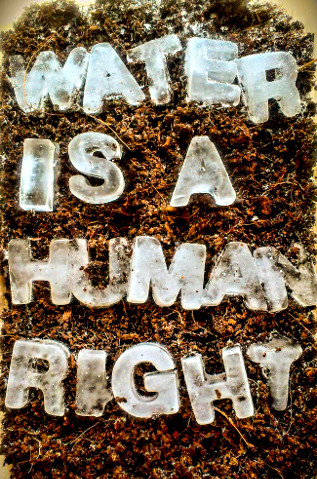
“Anything less than declaring water to be a human right is selling us short.”
Fliuch, Nov 7, 2016
The Thirty Fifth Amendment of the Constitution (Water in Public Ownership) (No. 2) Bill 2016 proposed by Joan Collins, Independent4Change went before the Dáil on November 09, 2016.
The bill was not opposed by the Government and consequently was referred to an Oireachtas Select Committee, the date and make- up of which is unknown.
It has subsequently come to our attention that there is disquiet about the wording of this amendment bill and it's scope.
Buncrana Together agrees with a critical article published by fliuch.org, Nov 7, 2012 in which the editor asks those responsible to think again. We produce this article in full below.
We hope that there is still time to amend the proposed amendment bill and we urge all TDs involved to consider what Fliuch has advised.
If we are going amend our Constitution let us do it right.
People are not thinking this through
The first time that many people in Ireland, even those within the broad Anti Water Charges movement, were made aware of the wording of this constitutional amendment bill or indeed that it was going before the Dáil, was when it appeared in the national media a few days prior to it being proposed in the Dáil.
For instance it was reported on Nov 07, 2016 in an article by Fliuch, a major anti Irish Water Ltd campaign group and media outlet, entitled 'Referendum on the Ownership of Water'
Fliuch's article reads
“There’s an article on The Journal website this morning about Joan Collins and her bill looking for a referendum, ( https://www.thejournal.ie/irish-water-referendum-2-3063361-Nov2016/ )
The wording of the referendum goes like this:
The government shall be collectively responsible for the protection, management and maintenance of the public water system. The government shall ensure in the public interest that this resource remains in public ownership and management.
Now. This is admirable but fatally flawed. Firstly, the proposal is to amend Article 28 – The Government. Article 10 actually addresses the issue of natural resources so we’re looking at the wrong section from the start.
Secondly, ‘public ownership’ is a very loose term. A utility could be publicly owned but still introduce punitive charges. In fact, if Irish Water Ltd was fully nationalised it might actually be able to use Revenue to collect water charges.
People are not thinking this through . Irish Water Ltd could theoretically remain in existence as a Water Authority supervising the councils and enforcing standards but the current wording of the proposed amendment to the constitution could actually make the situation worse.
If you’re going to amend the constitution with regard to water then you need to focus on Article 10 and you need to declare water, and access to clean drinking water, to be a human right (an affordable human right might even be acceptable) but anything less than declaring water to be a human right is selling us short."
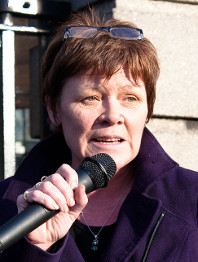
Joan Collins TD
Full Participation of Irish Citizens
It is surprising that this article seems to have been ignored within the anti water charges movement in general? However, it is not too late and we hope all supporting TDs will read and heed this important article. The public need to be part of the decision process, especially in this constitutional matter. They need to be fully informed and listened to.
If this principle is followed then the chances of a properly worded referendum succeeding will be greatly improved. Why can this not be done? After all there is a majority in the Dáil who have expressed a commitment to abolish Irish Water Ltd and Water Charges.
It should not be the prerogative of political parties, trade unions or indeed some in the Right2Water group particularly those in ‘The Pale’ to dictate the agenda. The people of Ireland are willing and capable of taking decisions when it comes to their future, protecting our rights and natural resources ( see Huge majority support Irish Water Referendum ).
Dáil Referendum Debate
In the Dáil debate, Nov 9, 2016, Fianna Fail’s Barry Cowen said
"his party would vote in favour of a referendum with proviso that it be ironed out at next stage."
We hope, in this next stage that all deputies take Fliuch's advise into consideration.
It is worth noting Deputy Thomas Byrne’s contribution,
“People are suspicious of the entire political system and they ask all sorts of obscure questions whenever, for example, a treaty is put forward at European level. People wonder if there is a hidden agenda in putting this forward and I have had to assure them on Facebook that there is not. Let us work together on this in the spirit in which it was brought forward and in which many of us have worked to promote this idea over a number of years, and let us do it properly. We have seen a Government proposal amended in this Oireachtas, when a flaw was spotted in the process of a constitutional referendum. There was toing and froing in the case of the eighth amendment and I am sure Deputy Joan Collins is not happy with the wording that was agreed. There was a history to it, however, so this has to be done really carefully. Nevertheless, we are supportive of the Bill and of retaining water and the sewerage system in public ownership.”
Possibly Deputy Mick Wallace hit the nail on the head when he said
“Like most people in Ireland, I do not think the water service should be privatised, but, sadly, unless we get rid of Irish Water, it might as well be privatised because that is where we are. For want of a better term, Irish Water is another version of the HSE and literally outsourcing just about anything it has on its table. It is carving up the country. We have Aecom in the Dublin area, EPS in the Cork area, Veolia in Kilkenny and Glan Agua in Galway. Between the four of them, they are literally taking over water provision in Ireland."
United Nations
Human Right to Safe Drinking Water and Sanitiation, page 51 states
“While international momentum toward broad-based support for the rights to water and sanitation is essential, the actual implementation of the rights depends heavily on national legal frameworks, anchored by constitutional and statutory provisions. In turn, these laws must give voice to national policies, and aspire to achieving universal realisation of the right, and be operationalised through a robust system of rules and regulations emanating from government institutions and, ideally, national water and sanitation regulators.
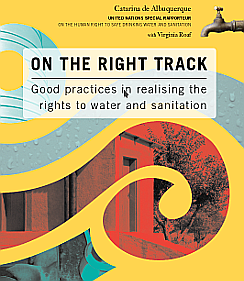
The strongest domestic legal frameworks exist where explicit recognition of the rights to water and sanitation is included in the national constitution. As the principal legal instrument describing the relationship between the State and residents, as well as the roles and responsibilities of each, such recognition underscores a national commitment to realising the rights for all people and ensures their lasting inclusion in domestic law. Moreover, the recognition provides a critical reference point for policymakers, government ministries, judicial bodies, and civil society, all of which aim to influence policy, set standards and hold the relevant actors accountable. At present, many countries have recognised the right to water in their constitutions.”
Sources :
Full Dáil debate http://oireachtasdebates.oireachtas.ie/
Fliuch article - Referendum on Ownership of Water
Complete amendment and stages
Download amendment
UN Water and Sanitation
Irish Constitution