
All hail the new Fianna Gael Alliance


The Irish, it seems, are too thick to think about more than one serious issue at a time, writes Gene Kerrigan

Gene Kerrigan
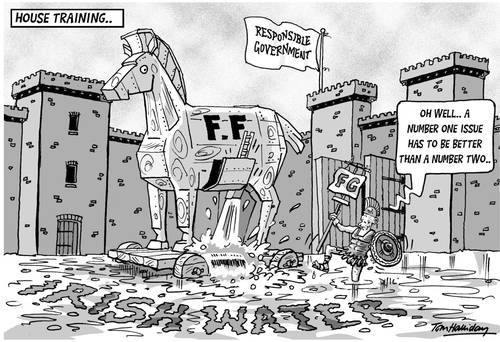
Cartoonist: Tom Halliday

Cartoonist: Tom Halliday

The Fine Gael/Fianna Fail Alliance, after spending two whole months forming a government, is agreed on the continuation of the Irish Water project.

Fianna Fail, being a party of principle, stoutly held to its election promise that it would not enter coalition with Fine Gael. They entered the Alliance instead.

Fianna Fail, being a party of no principle beyond its own advancement, readily agreed to ditch its election promise to "abolish Irish Water".

But, of course, Irish Water doesn't matter any more.

We're all agreed, are we not - the Fianna Gael Alliance, the Independent Alliance, and the officer class of the media - that there are "far more important issues" than Irish Water.

And it's only €3 a week.

They're right - in that most of us can afford €3 a week.

But they're also wrong. The combined actions of FF and FG, with their helpers, have resulted in the spread of low-wage jobs, so that more people than ever don't have a spare €3 at the end of the week.

There are other people who have the €3, but things are so tight that they have to choose carefully how they spend it.

And there are people who could manage the €3 but they figure they've already taken a financial hiding, to save the bankers and the builders.

Ah, but, say the Fianna Gael Alliance fans, surely there are more serious issues?

They're right - and, again, they're wrong.

They're right because the consequences of homelessness, or a chaotic public health service, or property speculation, or untreated mental problems, are far more serious than the consequences of water charges.

But, they're wrong in that we don't have to forget Irish Water in order to be angry at Leo Varadkar diverting millions from mental health resources. We know they have a low regard for us, but we're not nearly as dim as the average backbencher.

Irish Water has been about siphoning money from us, to no good purpose, but the long-term aim has been privatisation.

The protests have been about the money - and they forced FG/Labour to drastically reduce the charges. But they've also been about opposition to selling the water supply to private interests. Few things anger people more than being treated as a fool. And what has angered many, even those who reluctantly coughed up for the water charges, was the brazen way in which the parties tried to take us for a ride.

Where did Irish Water come from? What has been going on? Let's consider what we found out over the past two years.

A cynical Chicago politician laid down a rule: "You never want a serious crisis to go to waste." He meant that a crisis gives manipulative politicians an opportunity to get away with things that would arouse dissent in normal times.

From the 1980s, the Thatcher revolution spread the gospel of privatisation: transport, water, telecoms - the quality of services declined, as fat cats vanished over the horizon in trucks full of money.

In Ireland, the politicians followed suit where possible, and did so with their usual efficiency. Telecoms - closely followed by the Moriarty Tribunal; bin charges, closely followed by a decline in service. They're working on transport, and making a hash of it.

Privatising water was dicey. No one dared try it on.

Then, the bankers crashed the economy in 2008. And, you never want a serious crisis to go to waste.

In 2009, Fine Gael invented the notion of Irish Water; in 2010 Fianna Fail ran with it; FG picked up the ball after the 2011 election.

The European Central Bank, working to the same privatisation agenda, pushed things along.

This, of course, is all left-wing paranoia. Until you look at the record. Or try to.

What was discussed at Irish Water's initial meetings? That would be nice to know, but as RTE's This Week programme found out, a rake of meetings took place without the retention of minutes recording what was discussed or decided.

This is not at all usual.

The customary hordes of "consultants" feasted on the easy prey - a pack of cheetahs descending on a virginal gazelle. Around €50m was spent on consultants, we were told, then we got a total of €86m spent on consultants and lawyers.

A nominal €150m was set aside for setting up the company, with a "contingency" fund of another €30m - maybe that was for tea bags and Marietta biscuits in case anyone got peckish at those un-minuted meetings.

Irish Water furiously denied splashing bonuses around to the top staff. The top staff, they said, were given "performance-related rewards".

Half a billion was spent on meters. A vast Irish Water set-up exists to raise the money it costs to run Irish Water.

But, really, privatisation? They wouldn't be so manipulative, would they?

You can't sell a utility paid for out of tax. You must create a "revenue stream" to produce a profit for speculators.

We know that a PwC report commissioned by the Government wrote of "competitive markets in the water sector at a later date". It suggested Irish Water be designed for "the possibility of future retail competition".

We know that Eurostat wrote bluntly, in a letter to the Central Statistics Office, that "privatisation is ultimately envisaged". Outfits like Eurostat are used to calling things as they see them.

The CSO asked for that reference to be removed from the letter.

We know that when Irish Water started writing to us it demanded our PPS numbers: and our home phone numbers, mobile numbers, email addresses and bank account details.

Why did they need all this data? They said it was so they'd know where to deliver the water.

Eh, you've got a goddamn pipe leading to our homes.

They were creating a database that would be a lucrative asset when it came time to privatise Irish Water.

How do we know they would treat our data as an "asset"?

Well, when you ploughed through a difficult-to-read website you found that in a sale of Irish Water our data "will be one of the transferred assets".

Irish Water could transfer or process our data at will, the website said, and "by submitting data to Irish Water, the Customer agrees to this".

When they knew people were ferreting around their site, they took down the stuff about privatisation.

Oh, that old stuff, that was - well, we didn't mean to put that up, that was a mistake. Really.

Spontaneous protest, beyond anything that the Left could organise, sprang up. This forced the politicians to cut the bills, temporarily. The aim is to do whatever it takes to get us on the books, to create that saleable "revenue stream".

Protesters were bad-mouthed as a "sinister fringe". They were compared to Islamic State. Every mistake by any individual - and there were mistakes - was treated as a planned manoeuvre by the whole movement. It was not the media's finest hour.

Already, the politicians who have wreaked havoc on public health, asset-stripped the citizens and presided over soaring rates of suicide, tell us we must stop thinking about Irish Water. And think of serious issues.

As though we're incapable of taking a position on more than one serious issue at a time.

Already, I'm sorry to say - but not surprised - the media has joined in this meme. All hail, it seems, the new Fianna Gael Alliance! There will be fun to be had spotting the odd infight. But the media, I fear, is entering one of its "responsible" periods. As the cringe-making media performance on "government formation" showed, we don't have sources, we have handlers.

Original article: Sunday Independent May 1, 2016


Risteard Ó Domhnaill: From Corrib gas to a battle for the future of the Atlantic


Risteard Ó Domhnaill follows up his Corrib gas documentary with a remarkable new film about the political, economic and environmental threats to the Atlantic Ocean


It’s a story that hasn’t really been told. People don’t understand it.”

Risteard Ó Domhnaill, a filmmaker born and raised on the landlocked fields of Co Tipperary, is the first to admit that, for the average landlubber, it can be hard to picture the life of the sea, to get a sense of how the people who work it live their lives.

Ireland’s waters cover an area 10 times the size of our landmass and contain some of the richest fishing in Europe, but  Ó Domhnaill contends that we continually “turn our back” on that valuable resource.

“The way we look at the ocean, we always saw it as something related to emigration or tragedy or invasion,” he says. “Fish was something you get on Friday as a penance.  Mouldy, dry fish. We don’t have a positive attitude towards the ocean.”

Ó Domhnaill, a theoretical physics graduate and TV cameraman, has spent much of the past decade attempting to change this attitude. His first feature-length documentary, The Pipe, was a vital piece of independent journalism covering the controversial establishment of the Corrib Gas Project in Rossport, Co Mayo.

Through the lens, Ó Domhnaill witnessed a community organised in resistance against a violence all the more shocking for its proximity. What he captured is the spirit of the people fighting for what they believe is right. For all its political, historical and environmental import, The Pipe remains a charmingly intimate story.

His new film, Atlantic, picks up where The Pipe left off by following its ripples out into the wider world. Ó Domhnaill heads to Norway, Newfoundland and the Donegal coast to find stories that help elucidate the complex development of our offshore resources over the past 50 years.

Atlantic, which is narrated by Brendan Gleeson and was initially financed through a crowd-funding campaign, blends contemporary characters and archive footage to track the growth of big oil and industrial super-trawler fishing, as well as the decline of coastal communities in all three countries.

The film holds out hope that by learning from one another’s successes and mistakes, these otherwise disconnected communities might find better ways to deal with common threats to their livelihoods, communities and entire landscapes.

As Ó Domhnaill says: “Water doesn’t recognise borders.”

Climate change dominates

Despite rarely addressing it directly, the threat of climate change leaks through every scene in Atlantic. Coming off the back of The Pipe, Ó Domhnaill wanted to highlight the political and economic factors creating this “perfect storm” of overfishing and oil exploration, as well as exposing the agents profiting from it.

As he travelled up and down the coastlines, talking to people, a different story began to emerge.

“The game has changed in the five years since I started this,” he says. “The price of oil collapsed. Climate change became a much bigger issue. The issues with the ocean, environmentally, began to creep back in. Who knows what’s going to happen, what’s going to hit the ocean? Acidification, warming of currents? We’re facing a crossroads. We can’t just fence off our part of the sea and say ‘We’ll look after that’. It’s a much bigger challenge.

“The game has changed, the reality has changed, the science has changed. What’s more important now, what’s come more to the fore, is how do we manage this in a way that can sustain us into the future, in a way that we won’t destroy it?”

This is where Ó Domhnaill’s subjects shine. Whether sitting in a clapboard house in the tiny Newfoundland village of Renews with the Kane family, or fishing off the coast of Norway with Bjørnar Nicolaisen, Ó Domhnaill lets the people of these small, oft-forgotten communities tell their own stories. The stories, as edited by Nigel O’Regan, interweave, each strengthening the others’ experiences.

Nicolaisen is very articulate, explaining in what Ó Domhnaill calls a “very philosophical” way how our ocean resources need to be cared for. It’s an age-old truism about the environment, no less powerful for being repeated: if we look after it, it will look after us.

“They are people who don’t have a great education or anything, but they’ve got a knowledge and understanding far beyond an academic knowledge,” he says of these fishermen. “I’m trying to tap into that. I think Bjørnar’s message is very powerful. It’s about understanding the ocean, working with the ocean. Not just seeing it as something to grab, but as something you look after.

“You understand the cycles, you take what’s fair and it’ll always be there. That’s a real message that I want to come from the film.”

Counting salmon

At the same time, Atlantic is not a twee celebration of the local, the folksy or the home-grown.

Take Jerry Early, a fisherman from Arranmore island whose livelihood from salmon was destroyed by a change in the law. During the course of the film, Early ends up in court for bringing home wild salmon, a protected species, after catching them in nets intended for other types of fish.

“I didn’t try to romanticise Jerry,” says Ó Domhnaill. “No one is saying Jerry Early’s a saint. If he brought home an odd salmon or two he wasn’t supposed to, I’m not saying that’s right. But he’s the one with five fishery officers running around Arranmore island, hiding behind rocks, trying to catch him out for a few salmon. And yet there are no observers on the big boats offshore.

“It’s up to the audience to decide. They’ve seen Jerry’s story, they know he acted illegally when it came to the salmon – he didn’t throw the salmon back in the water dead. But, morally, where do your sympathies lie? He looks offshore at the super-trawlers just hoovering up fish and firing dead fish back.

“Which is the greater evil? Is it fair to just focus on punishing the smaller fishermen when, at the same time, you’re taking their livelihood away from them?”

This commitment to ambiguity, to not offering all the answers, is one of the great strengths of Atlantic. It reflects an uncertainty at the heart of the subject matter; how do we weigh up the ineffable factors of community, craft and tradition against the easily calculated profits of industry? Is something legitimate just because it’s legal? It’s a question that takes the viewer into a place of morals and values, and engages them in asking difficult questions.

There’s more to this than fighting for the little guy; it’s a question of how we want to live.

“How do you put a monetary value on a community?” asks Ó Domhnaill. “Take the Arranmore community. If you’re a civil servant looking at that, you’ll go, right, we’ll save a lot of money if we take these guys off the island and we put them in the town. The services will be cheaper, education, all that kind of stuff. It’s a very simple argument: ‘These are a nuisance.’

“It’s not until you actually immerse yourself in those communities that you realise the huge wealth in those communities that you can’t put a monetary value on.

“You can’t put a monetary value on culture, on heritage, on knowing where you’re from.”

Risteard Ó Domhnaill, filmmaker

Risteard Ó Domhnaill, filmmaker

Original article:  Ian Maleney, Irish Times, Apr 28, 2016

See also coverage of the film in The Irish Examiner April 26, 2016  Risteard Ó Domhnaill's new documentary 'Atlantic' focuses on fishing industry


Establishment reaches a deal


The Irish working class needs it's own party

 writes Anne McShane


Gerry Adams: preparing for power

Gerry Adams: preparing for power

After two months of political paralysis it seems a deal is in the offing to put a government in place in Ireland. After weeks of stand-offs it now seems that we will have a Fine Gael minority administration. An agreement has been reached with Fianna Fáil to support this government by abstaining on important votes for a period of two years.

At the centre of the agreement is a major concession by Fine Gael on water charges. Charges are to be suspended for nine months, while an ‘expert commission’ is set up to consider the situation and report to another committee - of TDs - which will then report to the Irish parliament, the Dáil. This is a highly risky strategy for the establishment. Even now, with the deal not even confirmed, the reaction from some quarters has been vitriolic. The former minister for the environment, Alan Kelly, a leading Labour TD, voiced his rage at Fianna Fáil for its imposition of this deal. He declared: “Politics is failing the people of the country again. Utopian populism is winning again.” On the other hand, FF had promised in its election manifesto to abolish the hated Irish Water utility - which now stays. It had also said it would suspend water charges for five years, not nine months. So it has effectively reneged on these pledges - which will cause even more tensions within its ranks. Fine Gael, which made its obduracy on this question a badge of honour, has had to fall on its sword.

Six years of mass demonstrations, boycotts, direct action and working class self-organisation has inflicted an important blow against the austerity regime, which has been enforced by successive governments. This has been a long, bitter struggle and even this partial victory will boost self-confidence. But it also raises many challenges which need to be faced up to. At the moment our class can do no more than voice opposition to measures taken by the government. We need a mass political party which puts forward the completely realisable perspective of ending the rule of capital.

Unfortunately the two main leftwing groups, the Socialist Party and Socialist Workers Party, fall far short of what is needed to make any real political advance. They have both formed ‘broad alliances’ to try and win more votes - through the Socialist Party-led Anti-Austerity Alliance and the SWP’s People Before Profit Alliance. Even the SP-SWP electoral pact was a very limited one - to win more seats through their combined resources, to gain more speaking rights for leftwing TDs in the coming Dáil. There seems to be an absolute refusal to go any further than this. The United Left Alliance, an important pro-party initiative in 2011, collapsed because of internal bickering and control-freakery.

Efforts need to begin again to unite our forces in a party. The left has a responsibility to lift its horizons. With all its limitations, the AAA-PBPA pact has meant an increase in the number of socialist TDs and given the working class a more coherent voice. Its newly elected TDs have been powerful voices. In the Dáil debate on the deal, Mick Barry of the AAA paid tribute to the working class movement and applauded the activists who had organised the struggle. He demanded the immediate abolition of water charges, their repayment and the dropping of all criminal charges against protestors.

SF threat

That FG and FF are united over the need to provide a stable government illustrates the extent of the predicament. Never before has either party been forced into a position of sitting down with the other to form a government. Now Fianna Fáil has suspended its right to behave as an opposition party for two years, although this will not assist it in warding off the threat from Sinn Féin. FF may already be regretting its last-minute decision to include such radical pledges on water charges in its election manifesto. Of course, it only did so to prevent SF eating into its own vote.

There is also pressure from the European Union, which does not want any backsliding on austerity. On March 29 advice commissioned by Irish Water was leaked to the Irish Times, which reported that the“legal opinion commissioned by the utility company says the state is required under EU law to keep the contentious regime in place”.   On April 25, with FG and FF closeted in talks, the European Commission issued a statement confirming that theEU directive on water is binding on Ireland. There is no way out without clashing with the EU. 

The aim of the ‘expert commission’ is, of course, to divert attention and allow some revamped charge to be introduced. Who the ‘experts’ are is anybody’s guess - presumably the usual dependable figures.

A major worry for the main parties is that all this will be a gift for Sinn Féin. SF has painted itself as the only coherent opposition and absolutely refused to discuss coalition with any of them. Instead it has pushed for FG and FF to bite the bullet and form a coalition. On April 6 SF lambasted leaders Enda Kenny (FG) and Micheál Martin (FF) for taking “so long to face up to the fact that neither can be elected taoiseach today without the cooperation of the other”. For SF it was “a matter of grave concern that the business of the Dáil has been effectivelysuspended for 40 days”.   Instead, according to Gerry Adams, “Sinn Féin will seek to provide progressive opposition to the conservative majority that exists, and I am firmly of the view that those who share this ambition must work together.” SF would become the clear opposition and use the unpopularity of a FG/FF pact to continue building up its own support.

In less than 20 years SF has gone from one rural TD to becoming the third force in southern Irish politics - emerging with nine additional seats from the 2016 general election - bringing it to 23 - as opposed to FG’s 50 and FF’s 44. It is without doubt directing all its energies to emerging as a major governing party in the next election. That it did not do so this time around is a source of disappointment among its members. Despite success in hitching the official leadership of the anti-water charges movement to its bandwagon, Sinn Féin did not make the breakthrough that had been predicted.

At the SF ard fheis (conference) last weekend, vice-president Mary-Lou McDonald accused Fianna Fáil of having stolen her party’s policy of opposition to the hated water charges - of being “Sinn Féin lite”.   The fact that she can make such a political attack tells us just as much about SF as it does about FF. They are rivals for a populist anti-austerity vote.

Left nationalism

One of the biggest problems for the working class arises from Sinn Féin’s posing left. While no doubt there are SF members who consider themselves socialist, the leadership is certainly no longer of that persuasion. A brief glance of its record in power in the north is evidence of this - it has cooperated in the programme of cuts inflicted by the Tory government. Its representatives argue that it is in a more difficult position in the Belfast assembly because of the sectarian divisions. Apparently it will be a lot easier in the south. That is absolute rubbish. In the south there will be the same kind of pressures that Syriza had to face in Greece - pressures under which SF, which wants to run capitalism more humanely, will be bound to buckle.

But illusions in SF are perpetuated by its inclusion as part of the left by the PBPA. Despite the leftwing impact of its TDs, the PBPA continues to peddle a populist programme. Its election manifesto did not mention the working class or socialism. Instead it claimed: “We do politics differently. We try to empower communities and unions. We see ‘people power’ as the way to bring change.”  The PBPA “represents a different form of politics, fitting for the 21st century. It sees ‘people power’ and the mobilisation of citizens in workplaces, communities and on the streets as the key to bringing change in society.” In its statement on the government’s retreat it continues to include Sinn Féin as part of the alternative.

The Socialist Party has been rather better. In fact there seems to have been a shift to the left within the AAA in response to Syriza’s defeat. It now makes a call for a socialist response throughout Europe and for the working class to play an active role in the setting up of popular assemblies and workplace organisations on a delegate basis. This would create “a weapon to take on and replace the old state machinery with a democratic and socialist state”. However, like its parent organisation, it persists in the call for a “radical left government” to lead this process.   Of course, Sinn Féin says that it is out to create a left government, which means that the SP/AAA is open to the accusation of offering de facto support to SF.


Original article:  Anne McShane Weekly Worker April 28, 2016