The battle of Irish Water. Another reason to heed protesters.

By James Quigley,  part one of a two part article


This article centers around Irish Water Ltd.  It questions the political, economical and social agendas of the some of the playmakers behind the multi billion euro project and criticises the ever growing influence they have on the Irish political system. 

The first article is a more generalised synopsis of what I believe are serious issues of political and social manipulation surrounding the setting up of the semi state Irish Water company.  The second article will be more specific and will zone in on some of the playmakers' involvement in the saga,  an elitist club of academics, professionals and multinationals forging what could be described as the equivalent of a masonic fellowship.


The 'one-arm bandit'  may seem a bit misleading. It suggests an Irish system as a game of chance. However, the reality could not be further from the truth. What one hand giveth, the other taketh away. All gaming machines in fact are rigged. Gambling generally is manipulated to give the owners the upper hand, the odds and permutations are studied to give optimal profit. They are calculated to draw you in, keep you hooked but extract as much cash as they can. Otherwise they would not be in business. Everything looks legit but in reality it is an illusion, a trick, the razmataz of tinsel town.


Largest project in history of the state

In 2014 Bord Gáis Éireann described Irish Water in a submission to the Joint Oireachtas Committee on the Environment as “one of the largest reform projects in the history of the State”.

Another interesting report and one which is at the heart of this discourse, 'Delivering Ireland's Water Services for the 21st Century' was prepared in 2011 by The Irish Academy of Engineering and Engineers Ireland. . It was presented to the Oireachtas, by Mr Gerry Grant, Managing Director, RPS.  Incidentally Mr Grant is now Managing Director of Irish Water Ltd.

It is not what the report advises that is important but it is the members of the report's taskforce that is revealing. It includes  RPS, Engineers Ireland, Irish Academy of Engineers,  State and Co Council employees and various individual private consultant firms.  We will focus on these groups in the second part of this article.  However, this group represents a quintessential example of the establishment joining forces with multinational corporations to set or influence the political and social agenda.  

This multi billion euro Irish Water project,  with approx €11bn of assets and nearly the same again in running costs, has indeed unearthed a can of worms.  Intrigues abound. Not only is it because of the vast amount of money involved but probably more so because Irish Water is what has been described as the 'largest reform project in history' that has attracted the interest of a myriad of multinational corporations along with  indigenous entrepreneurs and academics. Like a herd of sharks,  they have tasted the potential of this bonanza.

To some the Irish Water project may be  Shangri-La but to a lot of Irish people  it epitomises how our political, economical and social system has been systematically manipulated by global and indigenous interests for their own ends.

From Irish Water's embryo stage some 16 years ago right through to the Troika supervised formation stage,  2012-2014, to the present day political impasse,  Irish Water Ltd has a history of secrecy, controversy and  political manipulation.  It has seen the  involvement of  high powered multinational corporations and local Irish businesses  in the affairs of the state.  It is this relationship between the establishment, politicians, local businesses, academics and partisan group and  multinationals corporations  that is the driving force behind the Irish Water project.  It is this relationship that is at the heart of the controversy where one could nearly describe the outcome as a coup. 

The methods and techniques used by these elite forces are insidious, pervasive and relentless.  Because of present day economics Governments and countries are entrapped by the lure of employment and a quick GDP fix. It is a catch 22 situation where the elite use politicians and vice versa politicians use multinationals corporations to further each others agendas. Instead of pursuing quality of life, self sufficiency and indigenous employment we are sucked into a dependency of multinational corporations.  These corporations are by their very nature  transitory, adversarial, secretive and self-serving and extremely powerful. They have no allegiances other than the stock markets and profits. Barriers to trade and borders are broken down,  political systems are manipulated and politicians bought and sold.  

 Cultural diversity and political systems are harmonised to attain 'economy of scale', the be all and end all of the their economic structure. We all have to be the same, automatons, with the same needs and outlook in order to service this multinational imperialistic megalomaniac machine.


Great legions of lobbyists

Nothing as far as possible is left to chance, apart, of course, from the roulette wheel of the stock exchange.  Countries, political systems, market trends and the public have all been thoroughly assessed, researched and analysed. A methodology and model is developed to conquer the market.  Many of these corporations and even individuals have ready access to more cash than individual countries.

All our political, legal, educational institutions are used to further multinational corporations'  goals . Great legions of lobbyist, solicitors, engineering, planning and economic advisers are employed to copper-fasten their agenda.

The illusion of democracy and freedom is churned out through the controlled media, puppet politicians and omnipotent public relations firms. We are led to believe that all the endeavours are for the citizen's own good and the benefit of society.   There is never any mention of the vast profits to be made or the  control of political systems.  The public are constantly fed the idea of democracy and are told that they have a choice, a say in their affairs.  Half truths and diversions hide the fact that the illusion of democracy comes around every 5 years where we dutifully hand over the levers of power to political prostitutes and the sugar daddies. It is a merry-go-round, a house of mirrors, flashing lights and the jingle of change. Maybe we might walk away with the teddy bear or maybe nothing at all.

Ireland, it's people and it's politicians have been thoroughly assessed, surveyed, our habits and markets researched and analysed.  The elite have produced a model and a methodology to suit their philosophy. Such a model is Irish Water Ltd and an unmerciful propaganda war is now raging to consolidate the company and philosophy into the Irish system.

 Multinational  feast, of course, done through a competitive procurement process

Bord Gáis was chosen to oversee this project. In their 2014 submission to the Joint Oireachtas Committee they stated “Bord Gais was given a mandate to establish Irish Water as a key part of the water reform programme. We set out for Government our approach for delivering Irish Water back in January 2012......... Bord Gáis set out clearly, from the outset, that while the core capability to define what was required to establish Irish Water existed within Bord Gáis, it would require the use of specialist service providers to help implement this programme. In essence the Bord Gáis team in conjunction with secondees from the Local Authorities and the Department specified what was required. Bord Gáis used its experience and its existing systems and processes to define the requirements for Irish Water. ”  

The external services  and the costs were: IBM €44.8m, Accenture €17.2m, Ernst & Young €4.6m and KPMG €2.2m.

Up to 2014 Bord Gáis spent  the guts of €2bn including the above expenditure, their own running costs and that of the metering contracts of over €1.2bn. All metering contracts went to outside multinational companies including  Murphy Group, Coffey Northumbrian Ltd and GMC Sierra.  GMC Sierra a subsidiary of the infamous and former Siteserv, (now Actavo).  Last year Eurostat calculated that Irish Water expenditure to be €800m per year over a 8 year period until 2021. This figure will probably reach €1bn per year.   Incidentally there is no mention in the report of the Siteserv controversy or the offer made by Siemens to provide meters at a much cheaper price.  No everything was above board and contract awarded  "through a competitive procurement process".

Bord Gáis Éireann has since been split up, the lucrative part privatised and sold to Centrica plc in 2014. The unprofitable part is now called Ervia, a semi state company. Irish Water Ltd, apparently is a subsidiary of Ervia. Even Eurostat, an EU statistical office was not able to define the make up of Irish Water Ltd. Isn't it ironical that Bord Gáis the parent company who used it's own model as a template for Irish Water has been privatised and sold off. A bad omen for the future.

So you believe we have a democracy?

A quote from Ernst & Young, one of the external corporations hired by Bord Gáis in 2012 to set up Irish Water, “We have one strong global leadership team that sets one single global strategy and agenda. To ensure we are efficient and effective, we have organized our legal entities into 28 similarly sized business units, called Regions, in terms of both people and revenues. These Regions, almost all of which are purposely not single countries, are grouped into four geographic Areas:” 

What is Democracy?

According to political scientist Larry Diamond, democracy consists of four key elements:

(a) A political system for choosing and replacing the government through free and fair elections; (b) The active participation of the people, as citizens, in politics and civic life; (c) Protection of the human rights of all citizens, and (d) A rule of law, in which the laws and procedures apply equally to all citizens.

Democracy, he says, “must improve where it already exists before it can spread to other countries.  He believes solving a country’s governance, rather than its economy, is the answer. Every democratic country needs to be held responsible for good governance, not just when it suits them."

"Without significant improvements in governance, economic growth will not be sustainable.  For a democratic structures to endure – and be worthy of endurance – they must listen to their citizens’ voices, engage their participation, tolerate their protests, protect their freedoms, and respond to their needs.” The Spirit of Democracy

Shane Ross magnificent Dáil speech

Irish Water symbolises what is so wrong with Ireland today and so wrong with this government. It embraces so many wrongs and so many attitudes that so many recent that it has united unusual and unlikely forces against this government and Irish Water” he goes on to admonish the government of political appointments to the board of Irish Water.”  Shane Ross, 2014, Dáil Éireann


Eddie Hobbs Deep State

Democracy in Ireland partially exists every few years at election time when politicians and media make a little fuss and somehow cajole you into believing their myths. What they do not tell you or you don't seem to get is that you really do not have any power. Real power only exist in what Mr Hobbs calls 'Deep State'.”  Buncrana Together


Can the battle for democracy be won?

Taking on such a force may seem futile.   However, there is a chink in the elites' armour, an Achilles' heel.  This vulnerability is the absolute arrogance,  the flaunting of power, wealth and prestige, the condescension  and the manipulation of political processes and not least corruption.  Coupled with that there is a massive upsurge inpopular protest in Ireland against what is seen as corruption and wanton neglect.  It is this political awareness, the amount of contempt and the anger against the Irish Water project and the forces behind it that has the potential to put a stop to the elite's plans.

Somehow democracy has to be salvaged and wrested from the grips of the power brokers. The last stand could be the battle against Irish Water Ltd.   If the Irish Water model succeeds then it would be fair to say that corruption and anti democratic forces will have achieved their goals.

Bord Gáis 2014 Submission to Oireachas: https://www.water.ie/news/bord-gais-expertise-to-sa/Irish-Water-Submission-to-Joint-Oireachtas-Committee-14th-January-2014.pdf

Irish Academy of Engineers and Engineers Ireland report: Delivering Irelands Water Services for 21st Century

Ireland: a Recovery Built on Sand

by Cillian Doyle

Cillian Doyle is an economist with the People Before Profit Alliance of Ireland.

Cillian Doyle is an economist with the People Before Profit Alliance of Ireland.

Well, the latest national growth stats are in and, despite all appearances, the poster boy for  European austerity is hands down the fastest growing economy in the Eurozone. With GDP supposedly running at 7.8%, we’re even outpacing the global titans of India and China.

The US media outlet CNN claimed that once again ‘Ireland is booming’. Yes, there it was: the dreaded b-word. It’s not that an uptick in economic activity is unwelcome thing; it’s more that in an Irish context, owing largely to the weak nature of indigenous Irish capitalism, the word “boom” is usually synonymous with bubble, and it seems another bubble could be building, but more on that later.

For now, let’s focus on where this seemingly robust growth is coming from. It’s true there has been a slight uptick in genuine economic activity place here with growth in things like personal consumption and construction, but this certainly cannot account for our current level of GDP, which suggests the place is absolutely abuzz with economic activity.

How can this be? Well the reason is that Ireland’s is a recovery built on sand – and some highly suspect statistics.

The ‘great recovery’; the hope vs the hype

The final lines of CNN’s report alluded to the real reason for our eye catching growth figures, namely ‘Ireland is widely known as a tax haven’. Yes owing largely to our status as a tax haven/offshore financial centre, our headline figures are dodgier than Donald Trump’s hairdo.

GDP isn’t a great measure of economic well-being at the best of times, failing to capture things like inequality, but in Ireland it’s effectively useless. The profit shifting of the multinational sector has rendered us a complete basket case where those figures are concerned.

If we were fortunate enough to have a crusading media they would be pointing this out time and again. Instead we have the likes of the Irish Independent cheerleading for this faux recovery and carrying quotations from IBEC, our big business lobby group, that this new boom ‘was reaching every corner of the country’.

You see right now we have two rival economic narratives vying for supremacy. The first one, which can be considered the establishment’s version, tells the tale of a great recovery and finds regular expression amongst the talking heads in our mainstream media. The second, which is one of ongoing hardship, has to fight hard to get its message across.

There is however a number of individuals/institutions who do Trojan work in countering the often shallow analysis and outright spin which emanates from on high. These include the Unite Union’s Michael Taft, the Nevin Economic Research Institute, Trinity College’s Professor Jim Stewart and University College Dublin’s Dr. Conor McCabe. Their work is required reading for those looking to get an accurate picture of our current economic condition.

Three charts that blow the ‘great recovery’ apart

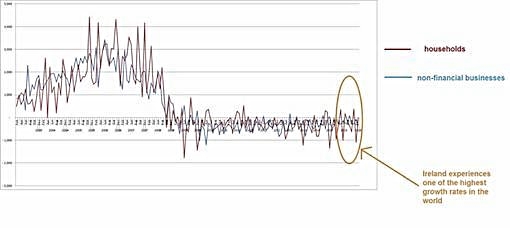
Conor McCabe’s chart below shows the gross amount of credit given to Irish households and non-financial businesses from period 2003 up until to today. This, in other words, is a measure of the increase/decline in the total amount of bank loans given to these groups in the period of the Celtic tiger and its aftermath. Naturally we can see high levels of credit in the run up to the 2008 as borrowing went hand in hand with the construction boom.

But if we look at credit levels today we can see they’re rock bottom, and yet somehow in defiance of all economic rationality we are recording massive levels of growth. Conor puts it nicely when he states, ‘Credit is the fuel for the engine. What we have here is a country that is claiming it can drive for 50,000 miles on a single tank of petrol. This is no economic miracle; it’s just bullshit.’

Credit Advanced to Irish households and non-financial businesses 2003-16

Chart 1. Irish Central Bank.

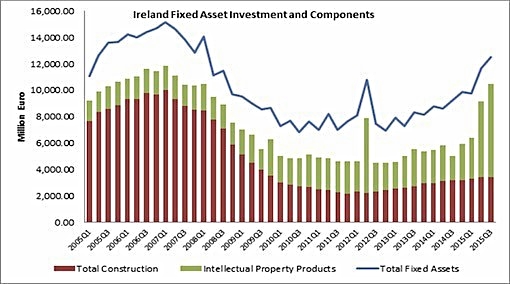
So we can see from the above that our growth is not being fuelled by credit, so what is driving it? Well that brings us nicely onto our next chart. Total Fixed Asset Investment or FAI is a measure of capital spending in terms of things like machinery, infrastructure, land, technology, etc. After all, you need to be building ‘stuff’ if you are going to build the economy.

Chart 2. Eurostat.

Construction is included under the heading ‘Total Construction’ to give you an idea of the impact that a decline in a major sector can have on an economy such as ours in the post 2008 period. Intellectual Property Products, which arise from investment in things like patents, trademarks, industrial design and copyrights, is included to highlight what is arguably the real driver of our current economic growth.

Take a close look at this ‘Intellectual Property Products’ measure. Anything look peculiar? Well we see spikes (Q2 2012; Q2 and Q3 2015) which seem to just double in the space of a few weeks and then disappear. There’s clearly something up here, and that something is patents. With multinationals starting to relocate some of their intellectual property out of ‘bad tax havens’ (Bermuda, Cayman Islands, etc) and into ‘good tax havens’ (Ireland, Luxembourg, etc) our growth figures were give a massive shot in the arm.

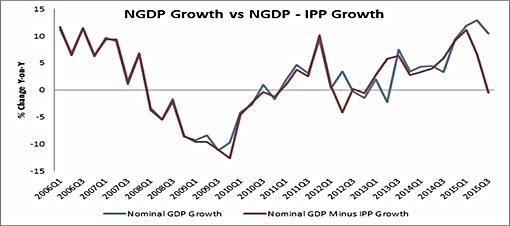
Our final a chart plots our nominal GDP growth together with GDP growth minus this IPP component. When we do this our supposed growth of 7.8% does the kind of disappearing act that the late great Paul Daniels would have been proud of. Some recovery, huh?

Chart 3. Eurostat.

As we’ve seen from above, the lion’s share of this growth is illusory. How many people does it take to administer the relocation of a patent to Ireland? Just a handful of select individuals, customarily derived from the usual firms Goldman Sachs, Arthur Cox, KMPG, etc, what the Tax Justice Network calls the pinstripe mafia. And whilst all this may be great for the bonuses of the bigwigs down in the Irish Financial Service Centre (IFSC), for the rest of us the effect is pretty negligible.

Back to the bubble economy?

Patrick Honohan, the former governor of the Central Bank, before riding off into the sunset warned that our growth figures were ‘seriously complicated‘ by ‘distorting features‘, which is pretty much what we have seen from the above.

The great boom that CNN reported on is really just a corporate tax bubble driven multinationals locating patents and other types of intellectual property here to dodge tax, hardly what you’d call laying the foundations for long term national recovery.

Is this country doomed to stumble from one tax break backed boom and bust to the next? Commercial boom and bust, property boom and bust and will it be corporate tax boom and bust? Because with the OECD’s BEPS project, the advent of Country by Country reporting, and growing talk of standardised European corporate tax rates, any of these could act as the pinprick for this this new bubble.

Given that it’s Eastertide, our establishment parties who are quick to crow about their Christian credentials, would do well to turn to their holy books for guidance. In Matthew 7:24-27 we hear the story of the wise man who built his house on stone contrasted with the foolish man who built his house on sand; ‘And the rain fell, and the floods came, and the winds blew and beat against that house, and it fell.’


Original article: Counterpunch April 7, 2016
More articles by:Cillian Doyle


Sinn Fein once again cloud the Irish Water issue - Lynn Boylan's faux pas


Lynn Boylan, Sinn Fein MEP, on 'Tonight With Vincent Browne' , March 29th,  2016, got into deep waters trying to explain Ireland's water derogation in Article 9 of the EU Water Framework Directive.  

Incidentally it really boils down to two words in clause 4 of that article, 'Established Practice'.  For a explanation of this Directive see  'Michael Noonan 'Water Charges Required Under European Law' is a Lie'

Ms Boylan lost an opportunity to dwell on what should be a major controversy in Ireland, involving threats from Irish Water Ltd's solicitors .  She said

"their remit is to manage Irish Water so why are they commissioning legal opinion in order to have an argument for their self preservation.  Was tax payer's money spent on this legal opinion and how much did they spend.  Those questions need to be answered". 

She should have insisted that this issue be discussed and brought other panel members into the debate.  It is a major substantial issue,  one which could easily have taken up the entire programme and one no doubt we all want an answer to.   Paul Murphy, Anti Austerity Alliance understood this importance when, earlier in the week, he brought the controversy up and sent a formal letter to Irish Water and the media requesting an answer.

Unfortunately, Ms Boylan's questions were sidelined.   In what seemed to be an prearranged schedule, she went on to give her opinion on the so-called 'Irish Derogation' in the EU Framework Directive, a complicated EU bureaucratic legal document.    Ms Boylan had a piece of evidence to hand which she read out verbatim.  From her demeanour she looked like she believed that this scoop was a coup de grace.  The evidence concerned Scotland's water provision model and their interpretation of the EU Directive. 

In retrospect she should not have complicated her first point.   She opened the door for the presenter to pin her into a corner where she had to explain how people inScotland pay for their water, i.e. Council Tax.  Ms Boylan then went on to bring Northern Ireland'swater model into the conversation.  Northern Ireland of course pay individually for their water through Corporation Tax.    

The statement was really Lynn Boylan's opinion, her interpretation of the EU Directive, nothing more.  Possibly her standing as an MEP gave it credibility but the Noonan article above mentions the opinions of two other MEPs.   The fact is we can all have opinions even Irish Water's solicitors (as long as we do not spend other people's money on it). 

When all is said and done our derogation exist with the words 'Established Practice' in there.  The next government should apply this derogation,  irrespective of what Irish Water or Mr Noonan says.  It will then be up to the European Commission to take it to the European Court if they think we are wrong.  Although not part of the above Vincent Browne video clip,  one of the panelists, Mr Sean Fleming, Fianna Fail, understood the point when he said that the present set up of water charges, as put in place by the former Fine Gael/Labour government, is not an 'established practice'.

Far from Lynn Boylan's statement,  being a "nail in Irish Water's coffin", as has been described on social media, it was another episode of Sinn Fein complicating the issue for other anti water charge campaigners.   Sinn Fein have been doing things their own way ever since the campaign started.  

Gerry Adams and other party members were in favour of water charges at the start.  Next they did not support a boycott.  Sinn Fein controlled Right2Change and came out with a unilateral election pact and orchestrated the expulsion of the Anti Austerity Alliance.  In 2015 Lynn Boylan was embroiled in a controversy 'Sinn Fein backed water charges in European Parliament'.  One of the most bewildering Sinn Fein's statement was the one by Eoin O'Broin, March 13th, 2016,  where he called for an independent commission on Irish Water to be set up and that Sinn Fein would accept the outcome, RTE This Week March 13th 'Sinn Fein Change of Position on Irish Water'.   Lynn Boylan recently dropped another bombshell, 9th March, which has never been adequately explained"Irish Water charges plan must be withdrawn before March 22nd deadline". 


Getting into a tizzy on EU bureaucracy ?

At the outset we have to ask the question why a Sinn Fein MEP is only now bringing up the question of such an important EU Directive?  Why has Sinn Fein's MEPs not been on top of this from the start and why have they not shared it with the Irish anti water charges' movement?

One of the reasons that the little derogation clause has sent politicians into a tizzy lately is because of a leaked threat from Irish Water Ltd's solicitors which appeared in The Irish Times, 29th March 2016;  'Water Charges irreversible in EU Law says Lawyers'.  

Another reason occurred three weeks ago when Michael Noonan, aformer Fine Gael Finance Minister,  issued a broadside to Fianna Fail;  'Michael Noonan 'Water Charges Required Under European Law' is a Lie'.   Here Mr Noonan was using the EU Directive as a bargaining ploy in Fine Gael's negotiations with Fianna Fail and other parties trying to form a government. 

These two revelations coming one after the other are very similar.  One would think that there may be a connection, designed to put pressure on the political discussions taking place at present on forming the next government.   The threats have come out about three weeks after the Irish General Election, the result of which was a stalemate where no party got a majority.    The formation of the next government is up for grabs.  Both Fine Gael's and Irish Water's futures are at stake.

Original TV3 programme: Tonight With Vincent Browne