
Fianna Fáil will chase anyone who has not paid water charges -Anti Austerity Alliance responds

It was reported by Niall O'Connor in the Irish Independent on March 18 that 'Over half a million households refusing to pay their water bills face having the charges deducted from their salaries or social welfare payments under a plan being devised by Fianna Fáil.'

Barry Cowen TD Fianna Fail.  Photo Tom Burke

Barry Cowen TD Fianna Fail.  Photo Tom Burke

The Irish Independent did not name a source other than 'a senior party source'.  The article went one

Non-payers will be pursued by a new, slimmed-down authority which the party says will be set up to replace Irish Water, the Irish Independent understands.

The confirmation that Fianna Fáil, like Fine Gael, intends to pursue those boycotting the charges removes another stumbling block to the two parties striking a coalition deal.

Having been accused of several flip-flops on the issue of water charges to date, Fianna Fáil is now adamant that bills issued must be honoured.

"You can't have one half of the country paying, and the other half refusing. We will address the issue of non-payment before we move to suspend charges," a senior party source told the Irish Independent.

Although consideration has been given to the introduction of tax credits for households who have already paid their bills, Fianna Fáil strategists now say dodgers will be pursued through the form of attachment orders.

This will happen under legislation introduced by Justice Minister Frances Fitzgerald last year, which allows State bodies like Irish Water to pursue debtors for bills of up to €5,000.

Read more: Fianna Fáil will chase anyone who has not paid water charges


Paul Murphy TD Anti-Austerity Alliance responds March 18 2016

Fianna Fail’s threats to deduct water charges is‘unworkable’ – legislation for deductions is only effective when debt reaches €500, however, if bills are scrapped debt will never reach €500.

Massive increases in non-payment will make ‘empty threats’ of FF plan.

Pursuing non-payers would mean hundreds of thousands of court cases.

The Anti-Austerity Alliance has responded to a reported plan by Fianna Fail to force payment of the water charges saying it is an ‘empty threat’ as non-payment has sky-rocketed and would be ‘unworkable’ because the legislation which they propose to use is only effective once a debt reaches €500.

Mick Barry TD said “Fianna Fail’s plan to try pursue people for payment of the water charges continues their back-tracking on their election promises and would be impossible for them to implement. The previous government’s threats and plans to deduct payment from non-payers was unworkable, the Fianna Fail plan is even more unworkable.

“Legally the legislation [Civil Debt Procedures Bill] which would be used to get attachment orders for deductions can only be used when the debt owed reaches €500, however, under Fianna Fail’s plan if they scrapped Irish Water and stopped issuing bills, people’s debt would never reach €500. So their whole plan is legally unworkable, before they even attempt to try to bring hundreds of thousands of people to court.”

Paul Murphy TD said “Since the General Election, non-payment of the water charges which stood at 50% has sky-rocketed. This makes any plan to pursue non-payers empty threats. These threats are part of a rear-guard action by them to try to hold back the flood of people cancelling direct debits and joining the boycott. We would encourage people to join the boycott, this will increases the pressure massively on all parties, but particularly Fianna Fail, while they are negotiating to form a government to not only scrap the charges but to refund people who have paid the charge."

Ruth Coppinger TD said “The election sent a clear message to all the political parties that people reject water charges. They should be abolished immediately, and people should be refunded. No government will be able to break the water charges boycott now.

“People need to increase the pressure on Fianna Fail to force them to commit to abolish Irish Water and stop these threats to non-payers. The plan to abolish Irish Water and have a new body chase up non-payment will be impossible to work out. We should now increase the pressure with the boycott and force the abolition of the charges and to scarp the bills.”

Update today March 18 - Conflicting statements

Barry Cowen on Uplands 103 radio

Fianna Fáil’s Environment Spokesperson Barry Cowen says no decisions have been made on the issue of unpaid water bills.

The Irish Independent reports today that the party will pursue those who fail to pay their water bills if in Government and that more than half a million householders face having payments deducted from their salaries or social welfare by a new slimmed down authority replacing Irish Water.

Offaly Deputy Cowen, who is part of the Fianna Fáil negotiation team meeting with other parties and independents, had told Midlands 103 that no discussions have taken place on unpaid bills.

He also says their position on charges is unchanged from the election manifesto which proposes abolishing water charges and Irish Water.
The Real Irish-American Story Not Taught in Schools

by Bill Bigelow in CommonDreams.  published on Thursday, March 17, 2016 by Zinn Education Project

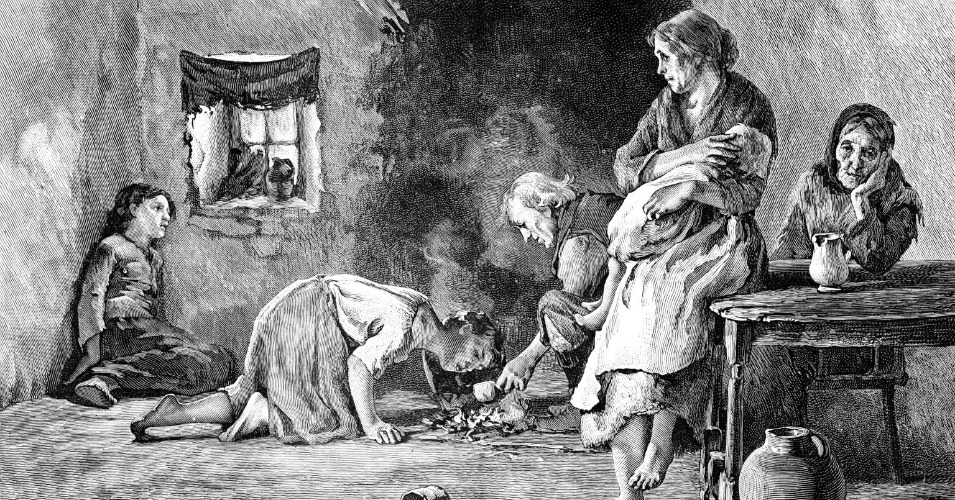
To support the famine relief effort, British tax policy required landlords to pay the local taxes of their poorest tenant farmers, leading many landlords to forcibly evict struggling farmers and destroy their cottages in order to save money. (Sketch…

To support the famine relief effort, British tax policy required landlords to pay the local taxes of their poorest tenant farmers, leading many landlords to forcibly evict struggling farmers and destroy their cottages in order to save money. (Sketch: The Irish Famine: Interior of a Peasants Hut)

“Wear green on St. Patrick’s Day or get pinched.” That pretty much sums up the Irish-American “curriculum” that I learned when I was in school. Yes, I recall a nod to the so-called Potato Famine, but it was mentioned only in passing.

Sadly, today’s high school textbooks continue to largely ignore the famine, despite the fact that it was responsible for unimaginable suffering and the deaths of more than a million Irish peasants, and that it triggered the greatest wave of Irish immigration in U.S. history. Nor do textbooks make any attempt to help students link famines past and present.

Yet there is no shortage of material that can bring these dramatic events to life in the classroom. In my own high school social studies classes, I begin with Sinead O’Connor’s haunting rendition of “Skibbereen,” which includes the verse:

… Oh it’s well I do remember, that bleak
December day,
The landlord and the sheriff came, to drive
Us all away
They set my roof on fire, with their cursed
English spleen
And that’s another reason why I left old
Skibbereen.

By contrast, Holt McDougal’s U.S. history textbook The Americans, devotes a flat two sentences to “The Great Potato Famine.” Prentice Hall’s America: Pathways to the Present fails to offer a single quote from the time. The text calls the famine a “horrible disaster,” as if it were a natural calamity like an earthquake. And in an awful single paragraph, Houghton Mifflin’s The Enduring Vision: A History of the American People blames the “ravages of famine” simply on “a blight,” and the only contemporaneous quote comes, inappropriately, from a landlord, who describes the surviving tenants as “famished and ghastly skeletons.” Uniformly, social studies textbooks fail to allow the Irish to speak for themselves, to narrate their own horror.

These timid slivers of knowledge not only deprive students of rich lessons in Irish-American history, they exemplify much of what is wrong with today’s curricular reliance on corporate-produced textbooks.

First, does anyone really think that students will remember anything from the books’ dull and lifeless paragraphs? Today’s textbooks contain no stories of actual people. We meet no one, learn nothing of anyone’s life, encounter no injustice, no resistance. This is a curriculum bound for boredom. As someone who spent almost 30 years teaching high school social studies, I can testify that students will be unlikely to seek to learn more about events so emptied of drama, emotion, and humanity.

Nor do these texts raise any critical questions for students to consider. For example, it’s important for students to learn that the crop failure in Ireland affected only the potato—during the worst famine years, other food production was robust. Michael Pollan notes in The Botany of Desire, “Ireland’s was surely the biggest experiment in monoculture ever attempted and surely the most convincing proof of its folly.” But if only this one variety of potato, the Lumper, failed, and other crops thrived, why did people starve?

Thomas Gallagher points out in Paddy’s Lament, that during the first winter of famine, 1846-47, as perhaps 400,000 Irish peasants starved, landlords exported 17 million pounds sterling worth of grain, cattle, pigs, flour, eggs, and poultry—food that could have prevented those deaths. Throughout the famine, as Gallagher notes, there was an abundance of food produced in Ireland, yet the landlords exported it to markets abroad.

The school curriculum could and should ask students to reflect on the contradiction of starvation amidst plenty, on the ethics of food exports amidst famine. And it should ask why these patterns persist into our own time.

More than a century and a half after the “Great Famine,” we live with similar, perhaps even more glaring contradictions. Raj Patel opens his book, Stuffed and Starved: Markets, Power and the Hidden Battle for the World’s Food System: “Today, when we produce more food than ever before, more than one in ten people on Earth are hungry. The hunger of 800 million happens at the same time as another historical first: that they are outnumbered by the one billion people on this planet who are overweight.”

Patel’s book sets out to account for “the rot at the core of the modern food system.” This is a curricular journey that our students should also be on — reflecting on patterns of poverty, power, and inequality that stretch from 19th century Ireland to 21st century Africa, India, Appalachia, and Oakland; that explore what happens when food and land are regarded purely as commodities in a global system of profit.

But today’s corporate textbook-producers are no more interested in feeding student curiosity about this inequality than were British landlords interested in feeding Irish peasants. Take Pearson, the global publishing giant. At its website, the corporation announces (redundantly) that “we measure our progress against three key measures: earnings, cash and return on invested capital.” The Pearson empire had 2011 worldwide sales of more than $9 billion—that’s nine thousand million dollars, as I might tell my students. Multinationals like Pearson have no interest in promoting critical thinking about an economic system whose profit-first premises they embrace with gusto.

As mentioned, there is no absence of teaching materials on the Irish famine that can touch head and heart. In a role play, “Hunger on Trial,” that I wrote and taught to my own students in Portland, Oregon—included at the Zinn Education Project website— students investigate who or what was responsible for the famine. The British landlords, who demanded rent from the starving poor and exported other food crops? The British government, which allowed these food exports and offered scant aid to Irish peasants? The Anglican Church, which failed to denounce selfish landlords or to act on behalf of the poor? A system of distribution, which sacrificed Irish peasants to the logic of colonialism and the capitalist market?

These are rich and troubling ethical questions. They are exactly the kind of issues that fire students to life and allow them to see that history is not simply a chronology of dead facts stretching through time.

So go ahead: Have a Guinness, wear a bit of green, and put on the Chieftains. But let’s honor the Irish with our curiosity. Let’s make sure that our schools show some respect, by studying the social forces that starved and uprooted over a million Irish—and that are starving and uprooting people today.

© 2015 Zinn Education Project


British army creates team of Facebook warriors

Soldiers familiar with social media sought for 77th Brigade, which will be responsible for ‘non-lethal warfare’

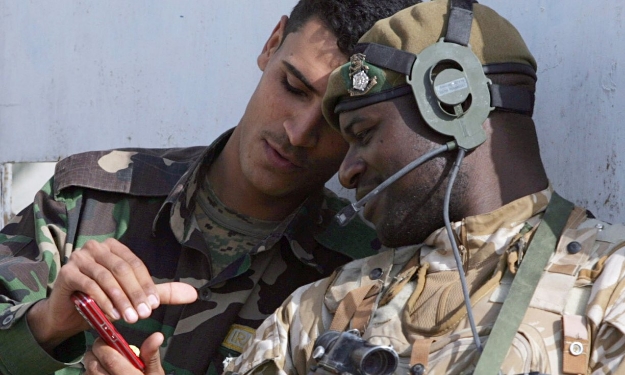
A British soldier looks at an Iraqi colleague's mobile phone during a joint patrol. Photograph: Matt Cardy/Getty Images

A British soldier looks at an Iraqi colleague's mobile phone during a joint patrol. Photograph: Matt Cardy/Getty Images

The British army is creating a special force of Facebook warriors, skilled in psychological operations and use of social media to engage in unconventional warfare in the information age.

The 77th Brigade, to be based in Hermitage, near Newbury, in Berkshire, will be about 1,500-strong and formed of units drawn from across the army. It will formally come into being in April.

The brigade will be responsible for what is described as non-lethal warfare. Both the Israeli and US army already engage heavily in psychological operations.

Against a background of 24-hour news, smartphones and social media, such as Facebook and Twitter, the force will attempt to control the narrative.

The 77th will include regulars and reservists and recruitment will begin in the spring. Soldiers with journalism skills and familiarity with social media are among those being sought.

An army spokesman said: “77th Brigade is being created to draw together a host of existing and developing capabilities essential to meet the challenges of modern conflict and warfare. It recognises that the actions of others in a modern battlefield can be affected in ways that are not necessarily violent.”

The move is partly a result of experience in counter-insurgency operations in Afghanistan. It can also be seen as a response to events of the last year that include Russia’s actions in Ukraine, in particular Crimea, and Islamic State’s (Isis) takeover of large swaths of Syria and Iraq.

Nato has so far been unable to find a counter to what the US and UK claim is Russia creating unrest by sending in regular troops disguised as local militia, allowing president Vladimir Putin to deny responsibility.Isis has proved adept at exploiting social media to attract fighters from around the world.

The Israel Defence Forces have pioneered state military engagement with social media, with dedicated teams operating since Operation Cast Lead, its war in Gaza in 2008-9. The IDF is active on 30 platforms – including Twitter, Facebook, Youtube and Instagram – in six languages. “It enables us to engage with an audience we otherwise wouldn’t reach,” said an Israeli army spokesman.

It has been approached by several western countries, keen to learn from its expertise.

During last summer’s war in Gaza, Operation Protective Edge, the IDF and Hamas’s military wing, the Qassam Brigades, tweeted prolifically, sometimes engaging directly with one another.

The new brigade is being named the 77th in tribute to the Chindits, the British guerrilla force led by Maj Gen Orde Wingate against the Japanese in Burma during the second world war. Wingate adopted unorthodox and controversial tactics that achieved successes completely disproportionate to the size of his forces, sending teams deep into Japanese-held territory, creating uncertainty in the Japanese high command and forcing it to alter its strategic plans.

In a nod to the Chindits, members of the 77th Brigade will have arm badges showing a mythical Burmese creature.

The aim is that the new force will prove as flexible as the Chindits in the face of the dizzying array of challenges being thrown up in the early part of this century.

The creation of 77th Brigade comes as the commander of Nato special operations headquarters, Lt Gen Marshall Webb, speaking in Washington this week, expressed concern about Russia and about Isis.

“Special operations headquarters is uniquely placed to address this,” he said. “We tend to take an indirect approach. We can engage without being escalatory or aggressive. We tend to view things from an oblique angle, and we absolutely acknowledge that trust, information-sharing and interagency collaboration is crucial.”

Article The Guardian Jan, 2016