
Austerity parties punished

Following the indecisive general election, Anne McShane discusses the rise of Sinn Féin and the divisions in the anti-austerity movement
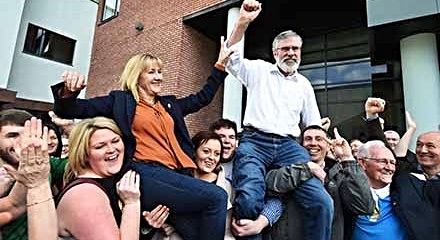
 

Gerry Adams and SF President Imelda Munster: celebration

Gerry Adams and SF President Imelda Munster: celebration

Article by Anne McShane, WeeklyWorker, Mar 3, 2016
 

The 2016 general election has resulted in a unique predicament for the Irish political establishment. The governing coalition of Fine Gael/Labour has taken a hammering, falling from a combined percentage total of 56% - and an unassailable majority in the Dáil - to a predicted 32%. For the first time Fine Gael and Fianna Fáil are contemplating a ‘grand coalition’. And that loyal lieutenant of the capitalist class, the Labour Party, has been humiliated too. The combined vote of FF, FG and Labour was 91.3% in 1982. Now it is less than 60%. More than 30% of the electorate has gone elsewhere.

Key to the crisis is deep hostility to the austerity offensive of the last eight years. The outgoing government boasted continuously of how it had turned the economy around. It omitted to say that any recovery that might exist (which is of a very tentative and sluggish kind, even according to its own economists) has been achieved on the backs of the working class. Since the ignominious collapse of the ‘Celtic tiger’ in 2008, two successive governments have overseen major ‘economic restructuring’ - in other words, massive cuts. Public-service workers and social welfare recipients were the first to be targeted in 2008, with €4 billion of swingeing cuts to wages, pensions, child benefits and social welfare. Hospitals, schools, unemployed workers and families went under the knife. In his December 2009 budget speech the FF minister for finance, Brian Lenihan, boasted that the worst was over - “We have now turned the corner.” A blatant lie.

There have been eight budgets between 2008 and 2014, imposing a total of €18.5 billion in public spending cuts and €12 billion in increased taxation. Health spending has been cut by a third, while repossessions have resulted in enormous stress and homelessness. Landlords have taken advantage by jacking up rents - while the government has slashed rent supplements. It is an intolerable situation for more than two million adults and children in receipt of some form of social welfare. Figures show that 30% of the population are now officially economically deprived, including two thirds of lone-parent families.1 Meanwhile, according to a recent Organisation of Economic Cooperation and Development report, Ireland’s rich have gotten richer - “there is a considerable gap between the richest and poorest - the top 20% of the population earn almost five times as much as the bottom 20%”.2

The FF/Green coalition went to the country in February 2011 and suffered what was described by the Irish Times as “the worst defeat of any government since the formation of the state in 1922”. Fianna Fáil lost 51 seats and the Green Party had an electoral wipe-out. The previous November the government had adopted a ‘national recovery plan’, with a commitment to reducing public spending by €10 billion and raising €5 billion in additional taxes. That was in return for a bailout of €67.5 billon from the European Central Bank and International Monetary Fund - €35 billion of that to go directly to the banks. This sparked tremendous anger among the population.

In response Labour Party leader Eamonn Gilmore pledged to end the crisis and ensure that the poor, unemployed and “ordinary families” did not suffer any further. He would renegotiate the troika deal, declaring that it would be “Labour’s way or Frankfurt’s way” - and he would not back down. His party could be trusted to be the voice of the working people in coalition with Fine Gael. On the back of these undertakings Labour more than doubled its vote - going from 17 to 37 seats, and becoming the second largest party. The majority of those seats were in urban working class areas.

But after only days in government it was clear that Labour had made false promises. Gilmore did not stand up to Angela Merkel or to the IMF. Instead his party joined enthusiastically with FG in implementing the troika deal, imposing five years of pain and hardship on an already suffering working class. It was a Labour minister, Alan Kelly, who took responsibility for driving through what has now become their Achilles heel - the hated water charges.

Resistance

The last eight years have seen huge outbursts of resistance. Protests erupted from late 2008 - firstly pensioners and then local groups began to stage regular marches against the bailout conditions. The first major demonstration - of 120,000 people - took place in February 2009 and public-sector workers launched a series of national strikes, with 250,000 taking action by November. Unfortunately - but characteristically - this militancy was sold out by the leadership in return for talks with government and employers. Further strike action was banned for four years under the ‘public service agreement’, with a pledge to cooperate with the reform programme. At a second national demonstration of more than 100,000 in November 2009, union leaders were heckled and booed. But by then they had stopped worrying about the rank and file - and had set about the task of getting Labour back into government.3

With the defeat of the public-sector workers, the protest movement was subdued until late 2011. Then students began to rebel in occupations and demonstrations. People returned to the streets in early 2012, with angry nationwide protests outside FG and Labour conferences. A mass boycott was organised against a new direct tax, the household charge, making it ultimately uncollectable. It became clear by 2013 that implementation was impossible without taking half of the country to court. That lesson learnt, its replacement, the property tax, was imposed through deduction at source.

2014 brought the water charge. This sparked a mass revolt, with demonstrations, occupations and the organisation of street and estate committees to prevent the installation of water meters. Stands-offs have taken place in towns and cities all over the country since 2014 and still continue. It is a war of attrition, with Irish Water being driven from a number of towns, as well as parts of Cork, Dublin and Limerick. Activists have been arrested and some are still awaiting trial for obstruction of water metering. As a result protests have now spread to the courts, with hundreds turning up to show solidarity.

The Labour Party leadership has taken a keen interest in hunting down transgressors. Current leader Joan Burton is chief state witness in a high-profile prosecution of Paul Murphy, the Anti-Austerity Alliance (Socialist Party) TD, and 33 others on inflated and hysterical charges of “false imprisonment”. In November 2014 Burton’s chauffeur-driven ministerial car was surrounded by protestors in Jobstown and the Gardaí were called in mob-handed. In the general election Labour lost both their Jobstown TDs - a fitting rejoinder.

Such is the hostility towards the charges that even Fianna Fáil included a commitment to abolish them in its election manifesto. Talk of going into a grand coalition with Fine Gael is complicated by this promise and the massive climbdown that FG would have to make. Those who have already paid are demanding reimbursement. Both Fianna Fáil and Sinn Féin have said that there will be no compensation, but this question will not go away if the charge is abolished.

Right to Change

The Right to Water (R2W) campaign was launched in April 2014 by the Unite and Mandate trade unions, along with Sinn Féin, the Socialist Workers Party, the Communist Party of Ireland and the Workers Party. From the outset it has been dominated by SF, in particular through the main R2W spokesperson, Brendan Ogle, an official of Unite. Ogle has been particularly antagonistic to the Socialist Party from the outset and has only suffered the SWP if it behaved with toadying loyalty.

R2W’s main focus until the general election was to call national demonstrations around broad slogans. Despite the mass boycott and the militant organisation on the ground, it has refused again and again to call for a boycott of the charges, or to come out in support of local direct action. Ogle cites problems for R2W’s component parts in calls to break the law. No doubt SF is the chief obstruction.

In late 2014, R2W announced that it would shift its emphasis away from demonstrations to the forthcoming general election. It declared that it was time to elect politicians who “enact laws that are wanted and needed by the people they are elected to represent”.4 R2W held two national meetings in May and June 2015. These events, misleadingly titled ‘conferences’, were nothing of the kind. Two of the three so-called pillars of the campaign - the political groups and trade unions - were allowed to send their own delegates. But the third, the ‘community pillar’, did not enjoy such representation. Local groups were not allowed to choose their own delegates, with loyal individuals being handpicked by Ogle and his allies.

R2W transmuted into Right2Change - a campaign to elect a slate of TDs. A “fiscal framework document” was produced to argue for “more than €9 billion in spending over four years”. This would apparently “help to create a fairer, more equal society with greater investment in jobs, as well as our health, education and housing systems, which are consistently starved of resources”.

A list of 100 candidates was drawn up. It was dominated by SF - and not only because it is the biggest component. InChange, a publication produced by Right2Change for distribution, SF candidates are number one on every list. I have been told that this was an “administrative error”, but even if it was it shows a certain mindset. This impression was strengthened by the appearance of Gerry Adams on the platform at a demonstration organised by Right2Change on February 20, the week before the election. He was given a unique opportunity to put himself and his party forward as the solution for the movement just days before voting.

Significant gains

The left was in a strange position in the run-up to this election. The United Left Alliance, which saw the election of five TDs in 2011, had fallen apart because of internal wrangling in 2013. Clare Daly and Joan Collins, two of the original five, stood as ‘Independents for Change’ this time. The SWP-led People Before Profit alliance stood under the umbrella of Right2Change, but also as part of a bloc with the SP-led Anti-Austerity Alliance (which remained outside Right2Change). This bloc - the AAA/PBP - stood 31 candidates. Six have been elected, with the SWP gaining two new Dáil representatives. This is a major boost for the left, and puts it on par with the Labour Party in the new Dáil. Three others came very close to getting seats.

Hopefully comrades Daly and Collins (both re-elected) will rejoin the organised left in the Dáil, helping to form a bloc of eight TDs. This would mean increased speaking rights and provide a more effective way of championing the working class in the chamber. The left results show that there is the space for a working class party and we urgently need to get our act together.

The left has been a consistent opponent of austerity and has also been at the forefront of demands for the abolition of the constitutional ban on abortion. This has brought it a lot of support from young people and women - many of whom took part in the successful referendum to introduce same-sex marriage. Without overstating it, there is today certainly a sense of far more assertive secularism in Irish society. The continuing unpopularity of the church has undermined its position so much that the main parties are completely out of step with the electorate on abortion.

Meanwhile, Sinn Féin has increased its vote significantly - thanks to the efforts of Right2Change and the lack of a working class party. It now has 23 seats - not that far behind FG’s 49 and FF’s 44, with, as I write, one count still to be completed. Gerry Adams is currently refusing to discuss coalition with FF - something which he has previously hinted was possible. Having seen the demise of the Labour Party, he has said Sinn Féin will not be in a minority in a coalition government. An alliance of the two main parties would suit him to the ground, as that would provide a clear opportunity to build SF as the party of opposition.

Of course, SF is not a working class party, but it has been successful in increasing its support in the absence of such a party. Sinn Féin is far to the right of Syriza in Greece and does not pretend to support any form of socialism. The AAA has been very critical of SF for refusing to rule out a coalition with Fianna Fáil, but now the SP comrades in the AAA are under huge pressure to drop this criticism. As far as Adams and his leadership are concerned, SF is the only alternative and all the left groups should help to build it.

Costs of scrapping Irish Water figures plucked out of thin air

Which person in the photograph below said this? 
 

"RPS were certainly not massaging the figures and I want to categorically refute that. In producing a final report, you produce drafts and you edit and you consult with your client, to make sure you get the right result, that is the way we produce reports. That you get a report, that the figures can stand up.  We would never change fact and we would never change our opinion. We might reword, we might delete, we might sharpen up text, to edit it. We would never change fact and we would never change opinion. We make our money on our reputation to be able to provide facts and to provide opinion. I think the entire judgement is wrong." 

Gerry Grant, Elizabeth Arnett and John Tierney, part of Irish Water Management team

Gerry Grant, Elizabeth Arnett and John Tierney, part of Irish Water Management team


Ever since the Irish electorate overwhelmingly rejected the Fine Gael and Labour Government on Feb 26,  there has been an onslaught from Irish Water and the media about the terrible costs the country will suffer if Irish Water is abolished.    Anyone listening to Irish Water's own figuresmight think that the constant reminders are designed to influence politicians while they are in deliberations about forming a government.  This could be described as political manipulation?   Indeed it smacks of scaremongering and the message of 'Irish Water can not be scrapped' is coming over loud and clear?  

In the grand scheme of things Irish Water Ltd is only a pawn.  In the long run it is the future of the country and it's resources that are at stake and the introduction and success of Irish Water is a political decision, one that is backed by high financial interests.    Irish Water, to survive,  will do and say anything.

In this scenario we have to ask, what if Irish Water have been advised by politicians and other interested parties to put into the public domain figures and a narrative so terrible that they, the politicians, can use?   They might say "we never believed it was going to cost so much or cause so much upheaval to abolish Irish Water".  A political way out will be manufactured so they have an excuse to wriggle out of what all along may just have been political opportunist's promises.

Scrapping Irish Water publicised costs

See today's RTE News article   Analysis, how much to scrap Irish Water?     In this RTE article, the figures or €5.5- €6.7 billion are quoted as total cost to scrap Irish Water.  The article states "This sum has been agreed by Irish Water regulator".   It did not mention who this regulator was but we can only assume that it is CER, Commission For Energy Regulator,  the very same body who, last year, controversially argued with Eurostat that Irish Water should be taken off the Irish Government's books.   It turned out Eurostat did not believe CER's fact and figures.  See Eurostat's decision Sector Classification of Irish Water.

Fianna Fail alarmed at Irish Water secrecy.
The official running costs of Irish Water is quite hard to fathom out and most figures we get are released by Irish Water or the Government.   Take for example Fianna Fail's article 'Government secrecy is preventing oversight of Irish Water' on Jan 11, 2016 where Barry Cowan,  said
“It’s alarming to see the Government continuing to prevent proper oversight of Irish Water. It makes you wonder what they are trying to hide, especially considering the number of complaints against the utility is on the increase.”

Eurostat only reliable source for Irish Water costs to date
We found out on Mar 26, 2015, from Eurostat's, semi redacted, report 'Sector Classification of Irish Water' , that the government's financial support to Irish Water was 'expected to be close to 800 million euro per year'. (page 12).   The report stated "Aside from current payments, government will also to a large extent fund the massive investment programme of Irish Water, foreseen to encompass 5.5 billion euro over 8 years." (page 3)

The same report,  stated that the government had "calibrated its support of Irish Water at 400 million euro in operational grants in 2015 and 480 million euro in 2016. " (page 2)

Eurostat reportstated in relation to Irish Water assets and employees
"Irish Water's consolidation of activities of the local water authorities is achieved , firstly, by the transfer of the assets (net value €7 billion euro) of local water authorities to Irish Water.  Secondly Irish Water retains all local authorities' staff in the context of 'service level agreements (SLA)...... as well as of significant 'management fees' to local authorities.   The SLAs will be in place for at least 12 years (until 2025).  De facto, most staff working for Irish Water is expected to remain employees of local authorities."  (page2)

There is a very interesting little piece of info hidden in the report's footnotes in page 3,which states

"The article 4.1 of the Articles of association however refers to 100 million shares of 1 cent each, half being A-shares, the other half being B-shares.  article 4.5 seems to allow for the consolidation of all shares held in a certificate, and to allow for limited shareholding (3 shareholders).  By and large it remains unclear which entity owns the shares

If Eurostat can't fathom the make up or structure of Irish Water Ltd, who can?  Maybe those elected TDs who are about to decide the future of this country might shed some light on the mysterious Irish Water entity.

So what do you make of that information? 
To us it seems the country could save quite a bit by scrapping Irish Water and in doing so we may get value for money.  Most water employees are still employed by County Councils.  These vital jobs can be saved but if Irish Water have their way they will be getting rid of most of them.  Last year they announced 1200 redundancies.  Even without Irish Water we can still be spending the allocated billions, not on the super quango but on improving our water infrastructure.

We have dwelt on Eurostat's facts and figures and not on the figures from Irish Water because they reflects the true costs and the value of assets.   Eurostat stated that Irish Water as it stands will remain on the Government's books for many years to come.  This would mean the taxpayers will be footing the bill.


Irish Water's facts and figures, the last gasp of a dying dynasty

Irish Water's reports on costs are what could be described as subjective, arrived at to suit a preordained end result.   Just like the Poolbeg case below.

An the answer tothe question is
This brings us to the original question at the start of the article where we asked which of the three people in the picture uttered the quote.  The answer is Elizabeth Arnett, Head of Communications in Irish Water.  And as you will hear she said it in the RTE clip below.

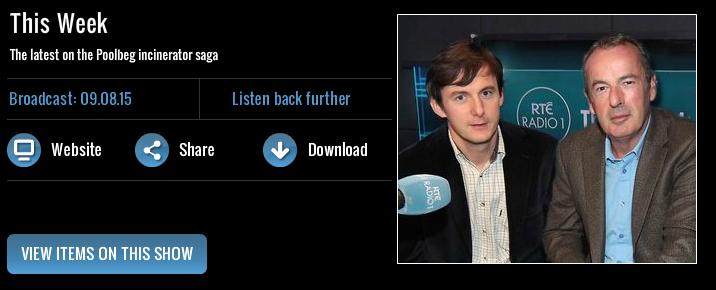
Listen to Ms Arnett interview below, on RTÉ Radio One’s This Week programme, 09/09/15.  Journalist John Burke reported that, after five years and €2.2million in legal fees paid by Dublin City Council, the council dropped its Supreme Court appeal against a High Court judgement made by Mr Justice Liam McKechnie in 2010.

In his judgement, Judge McKechnie found RPS Consulting Engineering – which had been hired by Dublin City Council to carry out a review of Dublin’s waste policy – had altered official data and waste reports to suit Dublin City Council’s agenda.

Click image to listen to Poolbeg controversy.

Click image to listen to Poolbeg controversy.

Read full story and links in our article 'We Make Our Money On Our Reputation'

What is interesting about is that Gerry Grant, John Tierney and Elizabeth are all working as top management in Irish Water.   Gerry Grant and Elizabeth Arnett held managerial positions in RPS Consulting Engineering and and John Tierney was Manager of Dublin City Council at the time of the Poolbeg controversy. 

Liam Deegan in Fair Society, Aug 09,2015 said of John Tierney " Until now John Tierney has blatantly refused to appear before the Oireachtas Environment Committee on the grounds that there is an on going EU probe into the cost of the Poolbeg incinerator debacle in which taxpayers were hijacked for €108 million Euro."

Incidentally, Philip Ryan, Irish Independent, 02/03/2016 in the article Irish Water to replace John Tierney with and Insider  informed us that the insider is none other than Gerry Grant.

Oh what a web of intrigues is Irish Water, what fanciful facts and figures have sprung from what seems a very close knit fraternity.

Last Word

The responsibility for our future lies with the opposition,  Fianna Fail, Sinn Fein, AAA/PBP, Social Democrats, Independent Alliance, and the various Independents.  Lets see and hear how they will live up to their election promises especially abolishing Irish Water and Water Charges, what the majority of the electorate have voted for.

And the last word goes to Fianna Fail's Darragh O'Brien, TD for Dublin Fingal.  He said in Fianna Fail's web page, www.fiannafail.ie,   "Irish Water needs to be turned off ". 
 

See article by Brian M. Lucey 'No Irish Water Won't Cost €7B'


Row brewing on Facebook with Fine Gael's Kate O'Connell TD deleting questions on Fluoride

Today March 4, 2016 there was a post on Facebook from Dawn Kelly accusing Fine Gael's Kate O'Connell, TD of deleting her questions and comments over O'Connell's post ridiculing anti fluoride arguments in Dublin City Council.  What is interesting about this controversy is that it highlights the issues of Fluoride in our drinking water.  It also shows how advocates of fluoride manipulate the facts.    In this case it is a Fine Gael newly elected TD Kate O'Connell, shown in the video below arrogantly dismissing and belittling fellow Councillors who dared voice concerns about Irish Government's policy of fluoridating drinking water.

Kate O'Connell,  Fine Gael TD won seat in Dublin Bay South, Feb 2016 election.  She was elected to Dublin City Council in 2014 for FG.

Kate O'Connell,  Fine Gael TD won seat in Dublin Bay South, Feb 2016 election.  She was elected to Dublin City Council in 2014 for FG.

Ms O'Connell,  in the video below, seems to assume a  rather doctrinaire attitude, waving away the opposition as irritants and  alluding to her profession as a chemist to emphasise her credentials.  It is a bit like Oppenheimer  saying that nuclear tests are not harmful to humans.   What the actions of O'Connell also highlight is once again an example of political parties reneging on elections promises.  Read the Irish Independent article link below.


Dawn Kelly's Statement

Kate O'Connell TD has just BLOCKED me from her page! 
Last night, I commented on her video about water flouridation.   I asked some reasonable questions and shared this link. FG back in 2001 promising to ban flouride in drinking water. http://www.independent.ie/…/fg-election-promise-to-ban-fluo…

Instead of responding she deleted my comments. So, this morning I asked again . Instead of her responding she has blocked me from commenting on her page and again deleted my comments.

What a totally outlandish way for an elected member of government to behave. A newly elected one I might add. If you can't answer simple questions who exactly are you supposed to represent. I am furious that she thinks this is an appropriate way to behave.


Dawn's deleted question
"It's me again.  You deleted my comments last night.  But to remind you ......  I asked your to back up what you said about Fluoride not being harmful. You also go against your own party's stance,  (see Independent article)  There have been many studies carried out on the toxicity of water fluoridation and it's harmful effects.  i also asked you to reply without being patronising or condescending as you have been in the comments on this thread.  Instead you chose to hit delete.  I find it hard to believe that this video is for anyone's 'Entertainment' as you put it.  This is a serious health issue and should not be made light of.  I am most interested in you explaining why your party, back in 2001 made an election promise to ban fluoride from drinking water based on medical grounds.  Are you telling me that your party is misinformed and doesn't know what they are talking about?  Do you mean to say that you know better?  Do you know better than the rest of the EU and many other countries who have banned this practice.   I understand that you are a pharmacist and while I respect that you will have more knowledge than some others on that panel, there are many, many others around the world who I am sure would be happy to debate with you on the topic if you were willing to listen.  I find your complete denial of the harmful effects of fluoride baffling."

The 'For Your Entertainment' video on O'Connell's facebook thread

Dublin City Council row over Fluoride in drinking water. Kate O Connell, FG councillor 'For Your Entertainment' facebook post.

50 Reasons To Oppose Fluoridation

See http://fluoridealert.org/articles/50-reasons/

In Europe, only Ireland (73%), Poland (1%), Serbia (3%), Spain (11%), and the U.K. (11%) fluoridate any of their water. Most developed countries, including Japan and 97% of the western European population, do not consume fluoridated water.

In the U.S., about 70% of public water supplies are fluoridated. This equates to approximately 185 million people, which is over half the number of people drinking artificially fluoridated water worldwide. Some countries have areas with high natural fluoride levels in the water. These include India, China and parts of Africa. In these countries measures are being taken to remove the fluoride because of the health problems that fluoride can cause.