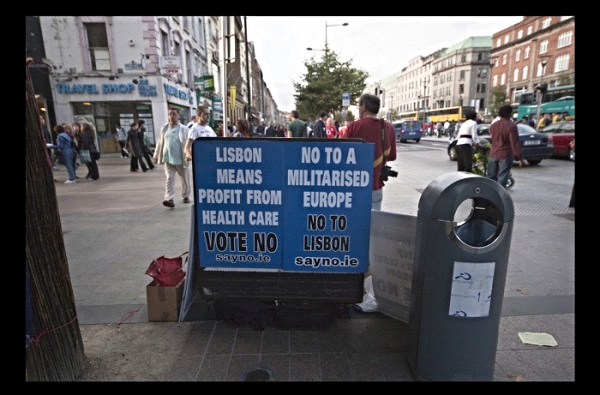
SIX YEARS ON SUPREME COURT CASE RAISES SERIOUS QUESTIONS ON VALIDITY OF LISBON-2 REFERENDUM AND “IRISH GUARANTEES”

Mr. Harry Rea (Applicant) and Ireland and the Attorney General, Maurice Coughlan the Referendum Returning Officer(Respondents) 2009/1042 JR.  Press Release - 2015-12-05
In the Supreme Court of Ireland on Monday 23rd November 2015, on appeal from the decision of the High Court, Application for Leave for Judicial Review, Mr Harry Rea, a plumber from Cork, presented a brief summary of his case to the Court.

He recalled that when the People voted in the second referendum on the Lisbon Treaty they did so on the promise that the “Irish Guarantees” would become a Protocol to the Treaty at the next accession treaty of a new member state. He said that the Court has to face up to the uncomfortable fact that the Irish State and the other States in the Union have failed to put that Protocol in place on the Accession of Croatia in 2013. That failure has effectively invalidated the Irish People’s ratification of the Lisbon Treaty. He said that it was against this background of Irish State failure and EU dysfunction that he was bringing the Leave Application.

His case is simple. The Government of Ireland negotiated a Treaty with the heads of the member states of the European Union in the form of a Decision. That Treaty put the protection of some of the Fundamental Rights of Irish Citizens into an international forum, in other words, the member states of European Union have guaranteed the rights of the Irish People.

Mr Rea asserted it is the responsibility of the Irish Government to protect Irish rights, However, the Lisbon Treaty Amendment to our Constitution does not contain any reference to the “Guarantees”. So the people were not asked to decide if they approved of the “Guarantees” Treaty made with the heads of state of the EU.

Article 29.4.9 can be invoked by a citizen if the State of Ireland adopted a decision to form a common defence policy in Europe that included Ireland. The Constitution in this Article mandates that the State shall not adopt such a policy. This is to some extent an expression of neutrality. It would have seemed a simple matter to have included all the guarantees in the same format – for example the State shall not transpose into Irish law any EU legislation that violates Irish Family Rights. In that way, any Family could invoke the Article to protect their rights against an EU law wrongly brought into force in Ireland.

He said, as the State did not include the “Guarantees” into the referendum they are not a part of Irish internal law and asked the question – “In what forum can an Irish Citizen invoke the “Guarantees”?

He said the State has alienated its responsibilities to protect our rights to the other member States of the EU. It is not within its powers to do so without approval from the people by way of constitutional amendment. The Treaty known as the “Guarantees” needed the approval of the Irish people.

He further said the disregard that the Irish State has for Irish Rights is plainly demonstrated by its failure to ensure that the Irish Protocol was put in place with the accession of Croatia to the EU.

Mr. Rea said that through the “Irish Guarantees” the State has made every other State in the European Union, apart from itself, responsible for questions regarding the Irish Constitution and the Rights of Irish Citizens thereunder.

The net result of this is that questions about Ireland’s Constitution, its meaning and interpretation, will be determined not in an Irish Court, but in a European Court in relation to the Treaty issues, whether in the form of a Decision of Heads of European States or as a Protocol.

Mr. Rea said that this was an impermissible alienation of powers. The people had never voted on the “Guarantees” and they do not form part of the amendment to the Irish Constitution.

The Court adjourned the case. The State will be asked to make submissions to the Court on the matter and Mr Rea was given three weeks to lodge an affidavit to inform the Court as to the accessible facts about the present status of the “Irish Guarantees” as a Protocol to the Lisbon Treaty.

For information and to contact Mr Rea:
Institute of Family and Marriage
National Office: Knockvicar, Boyle, Co. Roscommon
Email: familymen@eircom.net
Telephones: 00353 (0) 7196-67138 00353 (0) 83-3330256

Original article https://goodpointsite.wordpress.com/articles/press-release-lisbon/

Revealed: the pay and perks of your local councillors

* Average earnings were €30k * 11 earned more than €100k * €52m paid out in two years

Article by Paul Melia and Shane Phelan May, 2015

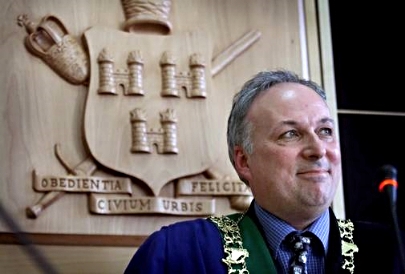
Dermot Lacey defended the payments to councillors, but said sums claimed for conferences were an issue. Photo: Steve Humphreys

Dermot Lacey defended the payments to councillors, but said sums claimed for conferences were an issue. Photo: Steve Humphreys

THE country's part-time politicians were paid an average of almost €30,000 each last year with 11 of them paid more than €100k each.

County and city councillors have received more than €52m in payments between them over the past two years, an extensive investigation by the Irish Independent reveals.

While the majority of these councillors earned the money on top of their day jobs, some have made a full-time living out of what is supposed to be a part-time role.

The money comes to them in salary, allowances, fees and expenses.

The revelations come as thousands of candidates hit the campaign trail in a bid to win a seat in the local elections on May 23.

Our investigation found that of the €52.2m spend, some €29.3m was on taxable salaries to 883 councillors.

The remaining €22.9m was made up of expenses, fees and allowances for attending conferences and sitting on a range of public bodies to which they have been nominated by virtue of being a councillor.

Some of these payments are taxable, while others are not.

One prominent local politician, former Dublin Lord Mayor Dermot Lacey, said it was clear some councillors "try to get on a number of bodies in order to supplement their income".

Details of the majority of this spending is not routinely published and had to be obtained, in most cases, under the Freedom of Information Act.

The expenditure, amounting to an average of €29,469 per councillor, comes despite councils warning they may be forced to cut services due to deteriorating finances.

In addition, 20 of the country's 34 local authorities are technically insolvent, relying on bank borrowings and overdrafts to meet day-to-day expenses and maintain services.

The investigation reveals:

* More than €200,000 was spent sending councillors on fact-finding trips to far-flung locations, including China, Japan, Abu Dhabi, Florida and California.

* The cost to the taxpayer for councillors attending conferences throughout Ireland came to more than €3m.

* One council paid university fees for two of its councillors, while another covered the cost of laptops and IT equipment for its members.

* Fine Gael councillors were the top claimers when it came to pay and expenses, averaging €30,731 each in 2013.

* Labour local representatives received an average of €29,254 last year, followed by Fianna Fail (€27,303) and Sinn Fein (€24,396).

* Several councillors claim expenses from third-level institutions, with one, Kilkenny councillor Mary Hilda Kavanagh (FG), getting €27,361 over the past two years, mainly for sitting on interview boards at Waterford Institute of Technology.

The Irish Independent investigation involved a trawl of records held by almost 100 different public bodies.

These included city and county councils, regional authorities, regional assemblies, HSE forums, third-level institutions, education and training boards and bodies dealing with fisheries, the Irish language and cross-Border issues.

However, a number of education and training boards, which are not yet subject to freedom of information legislation, refused to co-operate – despite paying expenses of up to €5,000 a year to some councillors sitting on their boards.

The figures obtained show the average sum paid to councillors has dropped by €1,000 since 2011.

The highest earning councillor in Leinster, Kildare's Michael 'Spike' Nolan Jnr (FG), who is a full-time public representative, defended the €135,000 he received in the past two years, when he was mayor of the county.

The sum included an annual mayoral allowance of €50,000, which was subject to tax.

EXPENSES

Mr Nolan said he and colleagues were unhappy with how the media portrayed council expenses.

He said he had worked "between 60 and 80 hours a week practically for two years" and had paid his taxes, PRSI, universal social charge and pension levies.

"It is not a case of getting this money, sticking it in your a**e pocket and two fingers to everyone else.

"It is not like that at all," he said.

Labour's Dermot Lacey, who received €85,755 for sitting on four public bodies in 2012 and 2013, also defended the payments made to councillors.

However, he admitted there was an issue over sums claimed for attending conferences.

"One of the problems is that some, effectively full-time, councillors have over the years used conferences in order to supplement their income and we need to get a way around that particular problem," he said.

Independent Kildare councillor Padraig McEvoy said there were question marks over the value of certain "spurious" conferences.

"I would like to see more rigorous reporting and evidence that the events gone to are worthy of the investment of public funds," he said.

indo.JPG

Irish Finance Minister Noonan Dumps Stocks to Buy Gold Read

Original article March, 2015

The Minister for Finance in Ireland, Michael Noonan, sold his shares in funds that track European and US stocks and diversified his portfolio including allocating some of his personal wealth into a gold exchange traded fund (ETF) in 2014.
 

Noonan sold out of his positions in the Lyxor Eurostoxx 50 ETF and SPDR DJIA ETF in 2014 and opted to invest in the SPDR gold shares ETF and Portuguese government bonds. He maintained his holdings in SPDR KBW Banks ETF, Ishares FTSE 100 ETF, Market Vectors Agri Business ETF, ETFS Agricultural Commodities ETF.
The information was published last week in the Register of Members Interests, in which members of Oireachtas – the Irish Parliament – must declare financial interests valued at over €13,000.

The changes to the Minister’s portfolio were highlighted by Ireland’s Sunday Independent yesterday, who described Noonan as “bearish” and interpreted the move as a “hedge against euro deflation”.

The piece acknowledged that gold is a safe haven – the “traditional hedge against tough times” and that “gold is an asset that has outperformed in times of both inflation and deflation.”

Noonan is believed to be quite a shrewd investor. The Sunday Independent reported that

Noonan’s personal investments give an insight into his thinking and his views on the risk and opportunities facing the global and European economies and markets. He has a track record stretching back decades of canny private investments.”

The news is of interest given Noonan’s status within the Eurogroup of Finance Ministers, the Council of the European Union and the Ecofin. The Economic and Financial Affairs Council (Ecofin), is composed of the Economics and Finance Ministers of the Member States, generally meets once a month under the chair of the rotating EU Presidency.

Noonan is an EU economic insider and would have access to good information with regards to financial and economic developments in Europe.

Noonan represents Ireland at these meetings and chaired the Council during the first half of 2013. He is committed to the European political project. The political opposition and an angry public have accused him of  putting the interests of EU banks and political elites over those of Irish society.

Given Noonan is close to EU elites, it is interesting that he chose to sell his European stocks and his allocation to Eurostoxx. Was the decision made prior to the ECB mooting the possibility of QE? If so it would suggest that Noonan may have been concerned about deflation. And yet the ECB never considered factoring the potential for deflation into its stress tests for banks.

Or was the decision made with knowledge of the ECB’s intention? If this were so it would indicate a lack of faith by a European finance minister in the ability of the ECB to achieve its stated objectives, given that QE should raise European stock markets.

Unfortunately, the Register of Members Interests does not detail the timeline of investments or their relative value so it is difficult to speculate whether the minister dumped his stock market investments prior to buying the gold ETF.

Noonan also bought Portugal 4.35% October 2017 government bonds. This either suggests that he has more confidence in the economic outlook for Portugal than for Ireland or more likely it is a form of diversification.

He continues to hold SPDR KBW US Banks ETF – which tracks US banks,  iShares FTSE 100 ETF, Market Vectors Agribusiness ETF and ETFS Agricultural Commodities ETF.

Whatever the motivation of a European finance minister to buy into a gold ETF – which, incidentally, is not the same as owning physical gold as it carries significant counterparty risk – it represents a significant shift in attitude toward gold.

It also demonstrates that the recovery narrative is not one that the Minister appears to have much faith in. Noonan is prudently hedging his bets in this regard.


click to view source article

click to view source article


Max Keiser talks about Finance minister Michael Noonan and his ridiculous and illegal stance regarding Irish Tax Payer owned banks.