Massive Meath Windfarm Rejected

The North Meath Windfarm Group announced in their facebook page   on Fegruary 5, 2016 that An Bord Pleanala rejected plans for a massive American owned windfarm in County Meath. 

Image from North Meath Windfarm Group

Image from North Meath Windfarm Group

"The American Developers of the massive Emlagh Wind Farm, have failed to get Planning Permission.  Bord Pleanala Inspector's recommendation for a Grant of Permission, was overruled by a majority vote of An Bord Pleanala 4-2"

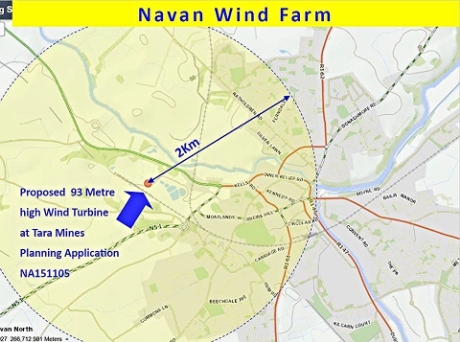
Mr John Callaghan from the North Meath group said in November 2015 "There is no place in Meath that is not under threat from Wind Farm development, not even the Town of Navan. Meath County Council are now considering an application for a 93 metre tall 1500kilowatt Industrial Wind Turbine to be located less than 1000 metres form Navan Hospital.
The Promised Wind Development Guidelines that might have provided protection have been postponed until after the Election.


See An Bord Pleanala's full report here Case reference PL 17.PA0038

Emlagh Wind Farm plans rejected.

Article from the Meath Chronicle Feb 5, 2016

Plans for the controversial 46-turbine Emlagh Wind Farm development in North Meath have been refused by an Bord Pleanala.
Element Power had sought permission for the construction of three wind farm clusters of up to 46 wind turbines with a maximum tip height of up to 169 metres and associated turbines foundations, hardstanding areas and drainage.
An oral hearing into the application held in the Headfort Arms Hotel, Kells, last Summer lasted for five weeks with submissions from 117 individuals and groups.
The inspector who conducted the oral hearing recommended that planning be granted for the development in his report but the board voted by a majority of 4:2 to refuse permission.
The Board’s decision was made having regard to the Wind Energy Development Guidelines, the policies and objectives of the Meath County Development Plan (noting the lack of a Wind Energy Strategy in the Plan), the need to treat wind farm development in the area with particular sensitivity given the proximity of the development to a large number of houses located in the open countryside and within a network of existing villages at Moynalty, Carlanstown, Castletown, Lobinstown and in the nearby town of Kells.

Image North Meath Windfarm Group

Image North Meath Windfarm Group

Other considerations included the location of the proposed development in an area with a history of settlement and an associated legacy of places and features of cultural importance from many historical periods, the character of the receiving landscape, the scale, height and number of the proposed wind turbines, the submissions received in relation to the proposed development and the report and recommendation of the inspector.
The Board stated: “It is considered that a wind farm of the scale, extent and height proposed would visually dominate this populated rural area, would seriously injure the amenities of property in the vicinity, would interfere with the character of the landscape and would not be in accordance with the overall development objectives of the Meath County Development Plan 2013-2019.


“Furthermore, it is considered that the proposed development would not align with the Wind Energy Development Guidelines as this guidance document did not envisage the construction of such extensive large scale turbines in an area primarily characterised as a hilly and flat farmland landscape and in such proximity to high concentrations of dwellings. The proposed development would, therefore, be contrary to the proper planning and sustainable development of the area.
“In deciding not to accept the Inspector’s recommendation to grant permission, the Board considered that, notwithstanding the provisions of the National Renewable Energy Action Plan, and other national and European Union policies in support of renewable energy development (including wind), the impacts of this very large development on the substantial local residential population, and the impacts of the proposed development on landscape and cultural heritage, would not be acceptable in this location. The Board further considered that the number and height of the proposed turbines would significantly exceed the landscape’s “medium potential capacity” to accommodate wind farm development as set out in the Landscape Character Assessment of the Meath County Development Plan 2013-2019.”
The decision has been welcomed by Senator Thomas Byrne, Cllr Darren O’Rourke and Deputy Helen McEntee.


Image North Meath Windfarm Group

Image North Meath Windfarm Group


Local Moville Greencastle Group 26 Years Battle with Government Gets European Backing

On February 1st,  2016, Mr Enda Craig, spokesperson for a local County Donegal community group, Save the Foyle, received a communication from the European Commission in Brussels. This correspondence confirmed the group's assertions that Ireland had not complied with an European Court of Justice C-50-09 judgement and the Environmental Impact Assessment Directive which was passed in 2011.  This means that the Irish Government will have to enact new legislation which complies with the ECJ C-50 ruling and the EIA Directive.  What it could also mean is that any relevant planning in Ireland since 2011 assessed under the old discredited legislation using the SI 684 Waste Water Directive, 2007 was illegal.

Save the Foyle is a local Co Donegal group from Moville/Greencastle in Inishowen. They have been campaigning for the past 26 years against plans by Donegal Co Council for a sewage treatment plant and to pump effluent into the mouth of Lough Foyle at Glenburnie beach.

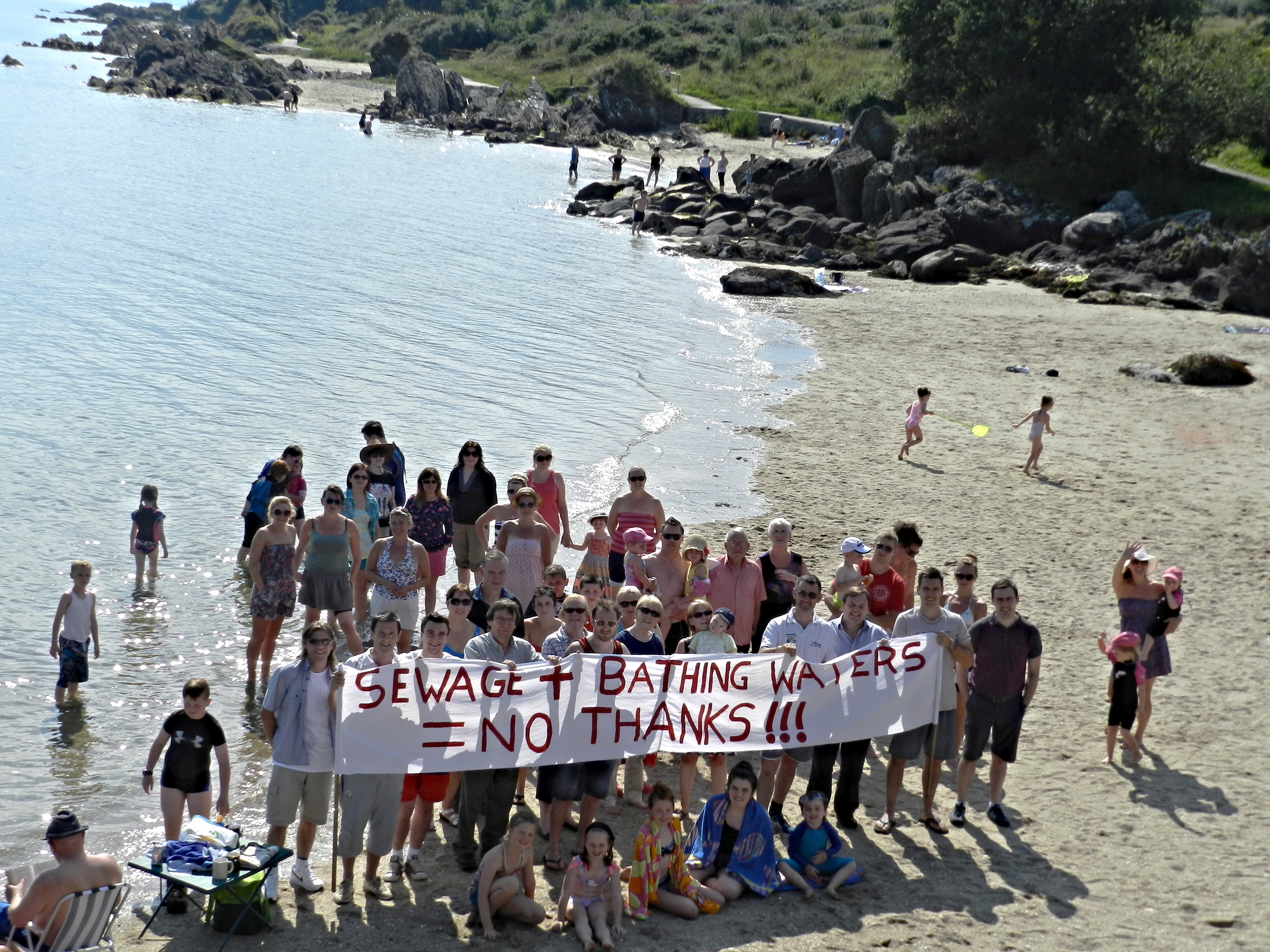
Glenburnie Beach, Moville, Co Donegal

Glenburnie Beach, Moville, Co Donegal

European Commission

Ms Antoinette Long,  European Commission Case handler for Ireland-infringements division in Brussels, responded to Mr Craig's request for clarification on a meeting between the Commission and the Dept of the Environment on November 17th, 2015 in Dublin.

That meeting came about after a 'Save the Foyle' delegation travelled to Brussels and presented their objections about Donegal County Council plans to the Commission.  They also put forward their contention that the Irish Government was not in compliance with the EU Directive namely C-50.09 judgement.

In her answer to Mr Craig's query, Ms Long stated that
“Irrespective of what may have been done in the past or of any preparatory work undertaken, we remain confident that no licencing decision will be taken (and consequently no building will be started) until the planned new legislation is in place and a licence has been obtained....... However, we believe that this legislation should ensure compliance with the C-50 judgment in the area of waste water discharge licencing. Therefore any future decision should and must comply with the judgment and with the EIA Directive.”

Mr Enda Craig's statement on behalf of 'Save the Foyle'

"This is what we have argued from day one and finally we have got someone to listen to our concerns. Most of our local politicians rejected us, Donegal Co Council and An Bord Pleanala rejected us, the EPA rejected us, the High Court rejected us as did Irish Water and the the Irish Government. It's a poor reflection on our country that its citizens must go to Brussels to access justice.

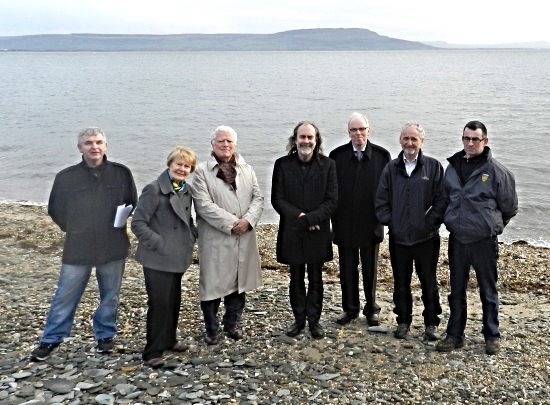
Save the Foyle,  Moville/Greencastle group with John Waters.  from left: Paul McLaughlin, Mrs Pat Hume, Dan McGuinness, John Waters, Don McGinley, Enda Craig, Thomas Farren.

Save the Foyle,  Moville/Greencastle group with John Waters.  from left: Paul McLaughlin, Mrs Pat Hume, Dan McGuinness, John Waters, Don McGinley, Enda Craig, Thomas Farren.

Now we have confirmation that Ireland was non compliant with very important legislation involving licensing and planning permission for waste water treatment plants. In particular for a case such as ours we have been seeking the protection of this and other EU legislation which was denied us in the lead up to and the granting of permission for the sewerage scheme.

This has implications for all major planning projects, particularly those that have potential to do serious damage to our environment. A discharge licence cannot just be tagged on at the end of a scheme that has already received planning permission. These schemes must not be split up into separate planning applications and must be assessed as one unit.

Save the Foyle have been down every road to highlight the idiotic decision of Donegal County Council to pump effluent into an enclosed Estuary when access to open sea is available.

In 1990 Donegal County Council elected members unanimously passed a motion to reject any proposal to pump sewage or effluent from the proposed Moville/Greencastle Sewerage Scheme into Lough Foyle and to relocate the proposed treatment plant and outfall pipe at a more suitable location outside of the environs of the Lough. This was overturned by an executive decision and permission was granted.

Ignoring this unanimous decision by the Council caused millions of euro to be spent on consultants proposing a scheme, an ultra expensive oral hearing, an appeal rejected by an Bord Pleanála (despite the opinion to refuse planning permission by the Boards Inspector on three separate occasions).

Our community has had to stump up and support me in an expensive High Court Challenge which I believe failed to identify the requirements of C50/09 in a case of such environmental importance.

Irish Water have taken over responsibility for the Moville proposed treatment works and it's discharge of effluent.

They should halt their plans to continue with procuring the scheme.  In the communication from Antoinette Long the Commission states that they anticipate the scheme cannot progress until new legislation is in place. 

Irish Water is throwing more good money after bad. This should not be an option.

The responsibility for past 26 years of hell that this little community of Carnagarve has endured must be placed directly at the feet of Donegal County Council.

After having democratically and unilaterally selected the perfect location for the disposal of the properly treated effluent into the Wide Atlantic, North of Greencastle in 1990, they have spent (or rather wasted) millions manipulating the disputed plans.

These 26 years have been made even worse by the despicable treatment we have been subjected to by most of the agencies we have had to deal with. These agencies, whose function should be to inform and assist, have shown themselves incapable of transparency when it came to applying regulations.

Nothing less than a wide ranging investigation should be accepted into the incompetence that has left this community without an up and running plant for this past twenty years.”

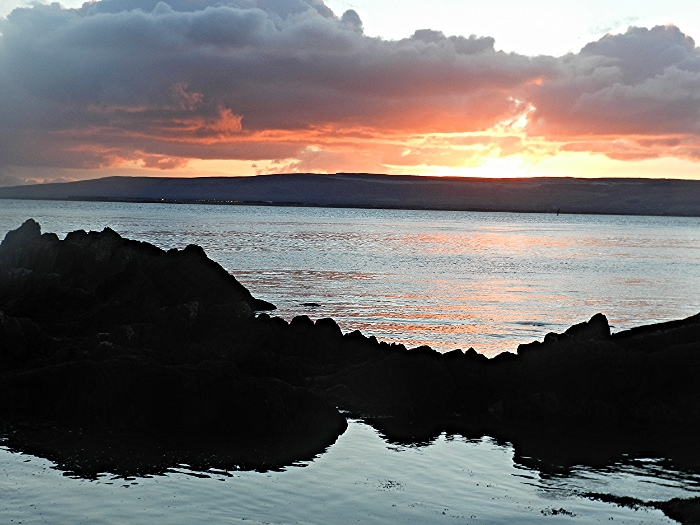
Sunrise at Glenburnie beach, Lough Foyle

Sunrise at Glenburnie beach, Lough Foyle

Read full ECJ Judgement on www.shelltosea.com
Read full history of the campaign here savethefoyle.com
For other background reading see article nobel-peace-prize-winner-the-sewage-plant-and-irish-water       


Marian Harkin, MEP

Marian Harkin, MEP

Midlands North West MEP Marian Harkin has praised the Campaign for a Clean Estuary in Moville after the EU confirmed to the group that Ireland was non compliant in relation to granting planning permission for waste water treatment plants, and new legislation is now necessary.

This impacts on the long running debate about the proposed treatment plant at Carnagarve, which local campaigners believe must now go back to the drawing board.

Marian Harkin says the group’s campaign has been pivotal in highlighting Irish breaches of EU regulations……….

Marian Harkin praises Moville campaigners

Buncrana Together

On the face of it you might wonder what is the significance of this ECJ C-50 judgement on a sewage treatment plant and a small, beautiful unspoilt beach in a remote corner of Ireland. 

To the handful of dedicated campaigners who have battled for 26 years, this is a major victory. 

However, it is not until you look into the implications this judgement may have nationally that you begin to understand the potential significance. The communication from Brussels regarding the meeting with the Irish Government last November, brings up major questions which must be answered.  For example why was the Irish Government's not compliant with EU directives since 2011.  Why did various planning and environment bodies doggedly pursue the Moville sewage plan under old legislation even though it had been made redundant since 2011?  Why were bodies such as Donegal County Council, An Bord Pleanala, the Environment Protection Agency complicit in the questionable plans?  Why did the Government squander millions of pounds of tax payer's money.  And many, many more questions need answered, not least why did they treat a community for 26 years the way they did?  


The Irish Water issue, nationalism, parliamentarism and community

By James Quigley

Statère_des_Parisii_Cl._I.JPG

Concentrate on the Water Issue, we need a victory

I have been calling for the Irish Water Campaign to concentrate on the water issue for quite some time now and as time has gone on, I have not changed my mind. The water campaign has been distracted by elections, political parties and a myriad of other issues to such an extent that we are in danger of loosing sight of our goal the abolition of Irish Water, privatisation of our natural resource, the structuring of this vital resource and the charging mechanism for it's supply.

The water issue must be won. The dejected Irish people need a victory and what better remedy for a depressed spirit than a victory by the people in a fundamental issue such as the ownership and organisation of our water supply. It is an issue which most people understand and feel strongly about. It is an issue which epitomises the failure in our system, austerity, corruption by several Governments. It epitomises, what many see as the sellout of our country.

The water campaign is winnable. This has been demonstrated numerous times in the past. The way to win, I believe,  is through the boycott campaign, remaining steadfast in our aims and publicising clear campaign goals. Let's not forget past campaigns where households in Donegal stood strong having their water supply cut off for almost 2 years.

Forget about the elections. I suppose that's going to be hard for the next six weeks. Maybe we should all turn off our tellies until the show is over. An infamous Labour Party man once brazenly said 'sure isn't that what politicians do at election time', while discussing politician lying about election promises.

A friend in the water campaign keeps pointing out to me that once we get the elections out of the way, we can then concentrate on the nitty gritty.  He also refers to the 'Local' as in working and concentrating locally, building community awareness.

I agree, both with the concept of 'local power' and with the idea that after the election we will separate the sheep from the goats, those who are sincere about the water campaign and those who were in it for self interest or party politics.

Political farce and election gimmickry

No matter who gets elected, parliamentary democracy is a farce.  Not only is the process of democratic elections a clever smokescreen, an illusion of democracy but also the parliamentary system is a corrupt and corrupting system and no matter how much tinkering that is done, nothing can reform such a system that we have in this country today. 

It is a bastard system, cloned together by church and foreign oppressors and proselytized by self serving local politicians, judges, clergy, administrators and intelligentsia.  Elections are a trick, a mirage of democracy.  We want so much to be free to choose, to elect that we do not see the big con job.  Behind the scenes, is the money, the big shooters with their legions of public relation firms, trends analysers, crunching the numbers,  the economical, political and demographical trends.  They explore statistics, your weaknesses to find out just what buttons to push.  You don't have a chance, like lambs to slaughter. 

Once again, at the 2016 general elections, we will be handing the gombeens power for the next 5 years.  It is not democracy.  It is rule by stealth where minority parties club together to clobber the majority.

Don't take me wrong, I hope the enlightened, angry Irish will flock to the booths and tick a box next to independent thinkers with integrity, socialists and anyone advocating direct democracy or a sovereign nation.  The Party system is an anethema and with it's strict whip system and leadership system is totally contrary to democracy.  Do not be fooled by the clarion calls of 'Strong Leadership', it is a synomum for dictatorship and a long way from democracy.  But I don't think the conservative electorate will change .  It will be the same old, same old with maybe Sinn Fein joining the party picking up the disaffected Fianna Fail ministers, thus becoming the main opposition.

This was told to me a year ago by a prominent Sinn Fein party organiser, who said that they weren't ready yet for power, that the water issues was an irritant and that a FG/FF was the preferred outcome. Interesting! the intrigues and posturing of parliamentary democracy. 

On a side note, anyone thinking that Sinn Fein is our great white hope, that they are our only chance of winning the water issue, well I would say think again. Not only are there any number of signs and facts that tell us 'beware' but also there are many more mind-blowing revelations that will come out about the insidious nature of the party.

Back to the Dail

How come the Dail is full of professional classes, doctors, lawyer, publicans, teachers, an assortment of buffoons who as soon as they enter the grandiose halls are somehow affected by the trappings and take on airs and graces, especially the art of politicians, the art of lying.  It is a club where you get up in the morning, check your bank balance, chauffeured to the haloed halls of the Houses of the Oireachtas where maybe you might have a pint or croissant in the Dail bar, have a chat attend a committee or two and if you feel like it go in for the odd vote just to tick your expenses card. Ding! 


The fundamental water Issue is the catalyst

If you think about it the water issue encompasses many fundamental concepts such as the rights of people, not least the vulnerable, all facets of life, the economy, our natural resources, our health, wealth and control of our destiny (I suppose that's a bit flowery) but nevertheless important.

The water issue is understood by most people and this is why we can win it. When the majority of people fundamentally understand the concept that is how we win it. Granted there are many who understand and have experienced austerity but it is the water issue that is the catalyst, the glue. It is too difficult to get bogged down in every issues but if we stick to one fundamental issue then we have a chance of winning the heart and soul of Ireland.

Future strategy of water campaign

First let me say that we have to free our minds,  think out of the box, expand our horizons, and become more independent in our outlook, believe in yourself.   Why are we so entrenched in the idea of leaders, hero worship, glory, riches, coming first at all costs?  Why are we becoming more insular and selfish?  Well it is all a device to keep you down, under the thumb.

Our immediate strategy in the water campaign should be to build on the boycott campaign. Forget about the elections. Already we have seen infighting and factions and power grabs. AndI am talking about the water campaign here.   After the elections and possible let-down, there will be enough left to fight and instead of elections we can concentrate on the campaign.  We can hit them in the pockets, we can hit them in their courts.  Remember, there has never been a case against a householder or Irish Water contracts etc, etc.  This has all to come.

We have to publicise our goals and how we intend to achieve these.  However, to do this we have to know what these goals are.  It is easy to say' abolish Irish Water', 'scrap the water charge'.  But how do we achieve these?  This is a fundamental problem within the movement and it has not been addressed.  Even within the movement the abolition of Irish Water is not a clear goal.

Personally, I think we should back the courageous SIPTU members in their call to bring back control of our water resources to the local authority.  It is this local control that is most important.  Control of this vital resource is nearer the community, less likely to be privatised and the expertise is there on how to run it.  Funding it should be through taxation and it is up to the Government to provide employment to all where we will contribute to this taxation.  The Government must not make scapegoats of citizens for their own ineptitude.

It is this idea of local control that is very important. I would add that it is this idea of 'local control' that is most important and is one that has brought me to the following concept.

Long Term, an Optimistic Plan and thinking out of the box

Abolish the Dail, that donkey sanctuary, and all its trappings and along with it the privileged, unelected senate, the wasteful presidential office, the Constitution,  the so called legal system, all the corrupt, irreformable, the labyrinth of outdated paraphernalia which we somehow thought a prerequisite of a modern country.

Through these systems which we aped or we were cajoled or lead into accepting, we have ended up with what we have today, a system corrupt, far removed from a pluralist, egalitarian society. We have been enslaved to the power of oligarchs, religious zealots and foreign influences. We have lost all control of our own destiny. 

We must discard the shackles, lock, stock and barrel and organise our society so that people have control of their own lives, free to choose, diverse in culture. We have to take our destiny into our own hands and not let eejits, psychopaths have control.

We have the wisdom, a natural Irish instinct, a culture, albeit a bit lost. We have the resources, our natural resources i.e water, gas, oil, land and sea etc.   Not only that we have the untapped ability of our people including all those who have been forced to leave the country.  Do you not think we are capable of much more?

The way to do achieve it is through 'Local'. We must forget about colonial and religious concepts of control and structure, the Dail and parliamentary trappings. We must wipe the slate clean and devise a system for ourselves. We have a history and past and a basic structure which we can draw on. From our forefathers, our rebels, our 1916 martyrs, our writers and scholars, our sad history or oppression, our clan system and the Brehon laws, we can organise ourselves much better. Basic structures are there, we only have to reorganise it.

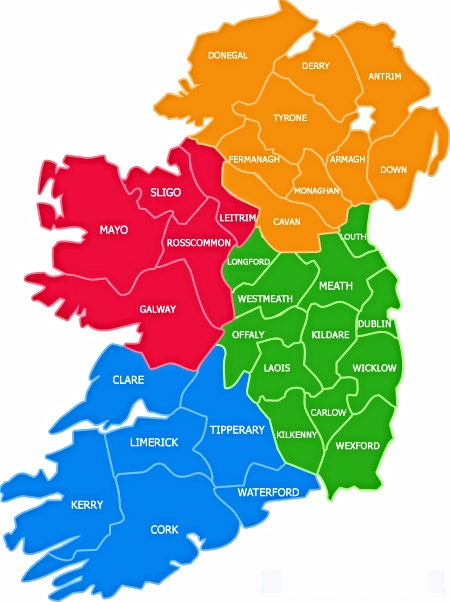
Instead of the clan system, we should think 'County', where each county is the clan.  Instead of the Dail we think County and Provincial organising structures i.e Munster, Leinster, Uster and Connaught.  Power devolved to the 'County', as close to the people as possible. This is where we have more control over our own lives.  This is where we have responsibility.

There are well defined and historical boundaries (even with it's own culture and language). This is not as far fetched as you might think. Structures are already in place, maybe not for long, the way centralised government and Europe are going. Already town councils have gone, and more and more executive control is taking over county level.

These county structures will have to totally be reformed,  copper-fastening representation of the people, the power to recall their representatives if they want, take away executive power and control of administration.  Give power back to the people.

Each County will be autonomous and run according to its citizens with reference to provincial agreements under a totally new constitution, new laws and legal system, (think updated Brehon Laws and the clan system).

There will be no corruption since the people will have control, no selling our resources, no North / South division, Catholic/Protestant. Co Antrim will have it's own power just the same as Co Kerry, no nationalism.  You could call it 'countyism'.  Sounds like socialism, doesn't it.  

The banking system could be run similar to credit unions and emphasis would be on co-operatives or worker's control.  I am sure if people had power they would make sure that our health, education and welfare systems would be geared to the community interest.

We have in place a very clever and capable civil service. This will continue but it must be reformed into a service for the people of Ireland, free of all political influences and party appointees.

Conclusion

You have the general gist. Just think what is possible and don't let narrow minded, self interested, party controllers damper your enthusiasm. Just tell them no thanks, they are telling lies and you do not trust them one little bit.

One of the best articles I have read on the subject The Irish Times and the late Peter Mair