About a year ago, Enda Kenny visited Roscommon town. Local party members awaited his arrival. As the Taoiseach's car drew up, a man named John McDermott stepped forward, hoping to speak to Mr Kenny.
McDermott was an independent candidate in the pending by-election. He wished to ask the Taoiseach why he promised before the 2011 election to keep open the A&E at Roscommon Hospital. And why, after the election, he voted to close it.
He was one of a small number of people protesting the broken promises.
As Mr Kenny's car stopped, a Fine Gael politician, Frank Feighan TD, put himself between McDermott and the car. He forcefully propelled McDermott away from the car and halfway back across the footpath. As he did so, with his back to McDermott, he repeatedly swung his right arm backwards, delivering several elbow blows to McDermott's midsection.
As he was pushed backwards, McDermott received a punch to his back from an unknown assailant among the Fine Gael supporters.
You can see the incident on YouTube. All 43 seconds of it. Search for "Kenny ignores attack" - a rather unfair headline, as there's no evidence that Kenny saw what happened.
Mr Feighan subsequently admitted the assault. "In hindsight, I misread the situation and overreacted."
Cut to Jobstown and the Joan Burton sit-down protest. As a result of that, Water Tax protestors have accused the Garda of political policing. Measuring the Jobstown affair against the Roscomon affair may help us understand why. Recently, for instance, gardai blocked the water tax protesters from collecting funds door-to-door in Tallaght.
Unlike large parties, with big donors, political campaigners such as the water tax protesters raise funds by asking for small donations from a large number of people. This is for posters, banners, transport, etc.
The Garda have cut off the campaign's source of funding by refusing a collection permit. They claim the money may be used for the "commission of an unlawful act".
Let us compare unlawful acts - what happened in Jobstown and what happened in Roscommon.
Someone threw a water balloon at Minister Joan Burton and it hit her in the face. Protesters sat on the ground in front of her car. It was a traditional sit-down protest, there was no violence.
Burton stayed in the car for over two hours, surrounded by large numbers of police, perfectly safe. Then, she transferred to another car and left the area. Protest over.
Sometime after that, tension escalated between local people and police in Robocop gear. A young man threw a brick in the direction of a police car.
Now, people should not throw things in the vicinity of other people. Even a water balloon. And certainly not a brick. The sit-down protest was legitimate. The fact that it went on so long was silly.
No one was hurt. Perhaps the balloon could be classified as an assault, but water balloons are children's toys. Kids throw them at one another all the time. The only damage done was to Burton's dignity.
The matter could have been dropped. Or there could have been minor public order charges. Instead, there is , if leaks to the media are correct, a liklihood of bringing people before a higher court where punishment, upon conviction, is greater.
The act of sitting down in front of a ministerial car has allegedly been interpreted as "false imprisonment". The punishment for that, in theory at least, ranges up to life in jail. And now, the police are preventing water tax protesters in the area from collecting donations from supporters.
Compare and contrast with what happened in Roscommon.
John McDermott was assaulted. It was a minor matter, spur of the moment, rush of blood to the head. No lasting damage, though he had a sore stomach. But it was an act of physical assault. In terms of seriousness, the Roscommon incident involved repeated body blows. There was no equivalent assault in Jobstown.
Fine Gael, quite rightly, has not been smeared as a result of the Roscommon incident. The media don't keep raising it, as they raise the Jobstown incident. They don't persistently demand that Fine Gaelers who weren't involved should condemn it. The local branch of Fine Gael has not been blocked from collecting funds.
If the Roscommon incident was treated as the Jobstown incident was treated, the fracas would have been blown up into a major scandal that reflected on the whole of Fine Gael. And there might even have been leaks to the media that Mr Feighan was about to be charged with attempted murder.
Ludicrous? Of course. But no more so than the treatment of the Tallaght protesters.
It's beyond question that the Jobstown incident received special treatment from the police. The dawn raids, the multiple arrests, the lengthy interrogations.
In an unprecedented move, someone leaked to RTE, details of the charges which are allegedly under consideration.
Revealing operational details of an unresolved case is interference with the administration of justice.
If any protester committed such a serious act there would be uproar among politicians and the media.
But no one cares about this serious crime. It was committed by "our kind of people".
Now, senior gardai are blocking the Tallaght protesters' right to collect funds.
It's two-and-a-half years since Clare Daly TD was stopped, handcuffed, taken to a station and put in a cell. The news that she was caught drink driving was immediately leaked to the media. The news was false.
There's supposed to be an investigation into that malicious leak. But the failure of GSOC in such matters is equalled only by the failure of the Garda Siochana to live up to the standards of the Keystone Kops.
If Lucinda Creighton or Shane Ross, for instance, received this kind of treatment there would be bloody murder in the media. Politicians would be aghast. Lucinda and Shane are "our kind of people".
The political establishment and the mainstream media don't seem to see those such as the water tax protesters and Clare Daly to be "our kind of people". They have the wrong accents. And, more important, they have the wrong politics.
The police should arrest anyone who commits a crime, and bring them to court.
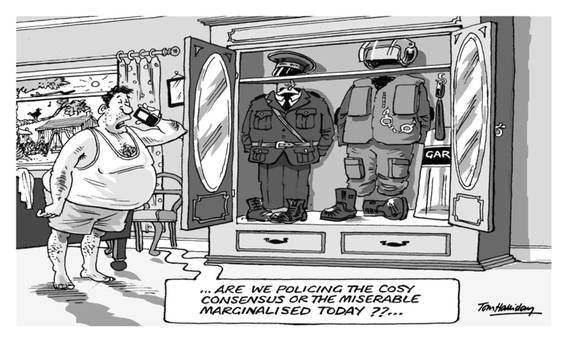
But, the police appear to see political dissent, in itself, as verging on criminal. Don't the police understand they have two duties - to protect order, and to protect the right to protest?
The political establishment is cool with undermining a basic condition of democratic governance - impartial policing.
And the media isn't too put out about it, either.
Voting is just one part of democracy. The essentials of democracy include an impartial police force and a media that protects points of view other than its own.
Without free, informed debate there is no choice. Without the right to campaign freely, there is no choice. Without choice, what is voting for?
Sunday Independent published Sept 9, 2015