
Commission for Energy Regulation to spend up to €800,000 on consultants


 The Commission for Energy Regulation (CER) is to spend as much as €824,700 on consultancy services for a project that it has not yet given the official go-ahead.

The National Smart Meter Programme is a €1bn project to install electricity and gas smart meters in all homes and most businesses by 2020.

Although the CER says the meters, similar to the one pictured, will allow consumers to avoid unnecessary consumption and cost by providing up to date information on their energy usage, the value of the project has already come into question.

The results of a cost-benefit analysis commissioned by the CER, which is overseeing the planned rollout of the programme to over 2m households, were found to be "marginally negative". However, an earlier report was largely positive about the project's potential impact.
Despite this the CER now plans to spend as much as €824,700 on consultancy services "provide technical expertise to CER" as it looks to move into the third stage of the project.
This stage is focused on the design and development of the meters as well as "consumer engagement programme".
Although the organisation said that it could not disclose the value of the contract due to commercial sensitivities, a notice posted online awarding the contract to UK firm energy consultancy firm DNV KEMA said that of the three bids submitted, €824,700 was the highest while €594,000 was the lowest.

A spokesman for the CER said the contract was awarded on a "draw down" basis, and will run until late February 2017.
He added: "The maximum requirement for the period of the contract is 450 days, drawn down as required.
"The CER does not guarantee that all 450 days will be drawn down, it will only be drawn as needed and so the final cost [which is] subject to the cap, is currently uncertain."
The CER also plans to run another cost benefit analysis, which is scheduled for the third quarter of 2016, before giving the project the final green light.

The body said that the results will "drive a Go/No-Go Decision on the nature of the rollout of Smart Meters". The CER spokesman said: "Given the scale of investment required to deliver smart metering, a thorough and robust analysis is required to substantiate any rollout decision. As the project moves through the phases of High Level Design and Detailed Design it is good practice to review costs and benefits."


The CER is Ireland’s independent energy regulator with a range of economic, customer and safety functions. The CER is also the economic regulator of Ireland’s public water system.


The CER is Ireland’s independent energy regulator with a range of economic, customer and safety functions. The CER is also the economic regulator of Ireland’s public water system.


The CER initially established the National Smart Metering Programme in late 2007. Estimates from the CER suggest that smart metering could require an investment of up to €1bn.
A previous cost-benefit analysis carried out by PwC, published last year, found the project could result in a net loss of €54m, although it said the findings should be viewed as "broadly neutral" given the project's scale.
Under the traditional meter system, many homeowners only get an estimate of how much electricity they are purchasing, but the CER claims they would get an accurate reading with the new meters. The visual display on the meter is intended to provide "real-time" information on the amount being consumed.

The rollout of electricity and gas smart meters is currently scheduled to commence in 2018, though the CER notes that this "depends on many factors".

According to its most recent annual report, the CER spent €2.5m on consultancy services on the Smart Metering Programme in 2013.



Irish Water in Row with Councils over millions of euros in levies

Irish Water has been given powers to grab millions of euro from every local authority in the country to help fund upgrades of the network.

But the company and councils are still locked in negotiations over the value of funds to be transferred, despite months of talks.
The money was levied on builders in recent years to help provide water and wastewater services for housing, commercial and industrial developments.
Despite no longer having any role in building new treatment plants, the money remains within the control of councils.


The delay to recoup the cash, which should have transferred last Wednesday, comes as the first water bills begin arriving in people's homes.
More than 100,000 householders have been hit with demands for payment which will be used to fund day-to-day operations and to finance upgrades to water and wastewater treatment systems under an ambitious €1.8bn capital investment programme.
Among the reasons for the delay in transferring the money across include disputes over levies which have been charged but not paid, sources said.
There are also issues around the role that councils will have in collecting outstanding amounts, and what will happen where local authorities allowed developers to repay outstanding amounts over time, and as projects were completed.
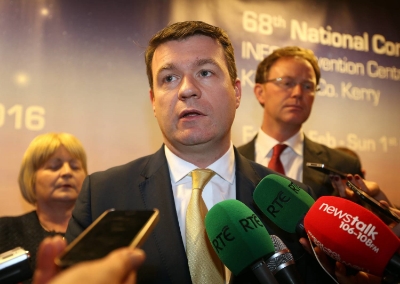
The development comes after Environment Minister Alan Kelly signed a vesting order this week which transferred any money "received or due to be received" in development levies by the local authority to Irish Water.
The amounts involved are understood to be substantial - at the height of the boom in 2007, more than €900m was levied in development contributions. Between 2007 and 2008, some 37pc of all levies were used to fund water, wastewater and sewerage works, meaning it is a key source of revenue to help improve the network.
In a statement, Irish Water said it was not in a position to state the amount to be transferred.
"The due diligence exercise to determine the value of development levies received by local authorities that vest in Irish Water is ongoing," it said.
"Therefore, we are not in a position to state the value of development levies that will vest."

Catherine Murphy

Catherine Murphy

Independent TD Catherine Murphy said that levies had been a "critical source of revenue" to fund water upgrades in recent years, and that the delay was among a "long list of failures".
"It has been a critical source of revenue, this is a critically important fund," she said.
"This is on a long list of failures where there hasn't been any thought in terms of what it would take to get Irish Water up and running. I don't think Irish Water will get past the Eurostat test, and I think significant numbers won't pay and I don't think it will survive."
The issue of development levies is among a number of financial matters Irish Water is currently discussing the local authorities.
Another is the question of how much debt will transfer to the utility, money which was borrowed in recent years to fund water and wastewater treatment plants.
Development levies vary by each local authority, but in Dublin City a levy of €57 was charged for each square metre of residential development, falling to €46 per square metre of industrial or commercial building.
Since January last year, councils no longer charge a levy for water services, instead it is charged by Irish Water.

By Paul Melia Independent.ie


Irish Water: News From The Hub Ireland - Tsunami of Litigations. - Bills Sent to Dead Man

Photo form Fair Society

Photo form Fair Society

Tsunami of Litigations Over contracts

We got our 'bill' today and opened it.  We honed in on the 'thank you for registering with Irish Water' comment and decided to ring them.  We pursued it down the phone and insisted on knowing precisely when and how we had registered.
We were informed that we had registered on a date in February over the phone - we explained categorically that this was not the case.

The operative went away for a while and came back sounding very unsure.
At this point we called everything in - suspecting that an act of fraud may have been committed.
If someone claims that we made a phone call blah blah! sure you guys do this every day.....
But we demanded a transcript of the call in question, plus the call we
 

were currently on, and copies of all data relating to ourselves that they may have obtained.
I would hate to think of tens of thousands of people making similar phone calls and questioning how and when these were set up. It would be terrible. I'd hate to see such a 'excuse the pun - tsunami of litigation concerning fraudulent misrepresentation of contracts.

By the Hub Ireland

Irish Water Sends Bill to Dead Man

A widow of a deceased man from Gorey Co Wexford wrote in The Hub Ireland " I'm at a loss for words... not only did Irish Water send the deceased man a bill but acknowledged on said bill he died. 
This morning's post. Two letters from Irish Water addressed to my deceased husband. Nearly 6 years dead and you dare to put that on a letter. No, I will not be contacting you to clarify your error".  She went on to say that she hopes she is the only person this has happened to "as this is a callous disregard for human decency."

The Irish Times  quoted a spokeswoman for Irish Water  “Irish water will be sending bills to 1.5 million customers over the coming eight weeks.

“It’s a significant task and we expect to face challenges where we have incomplete customer information, where customers have not yet registered or where customer information needs to be updated.
“We totally understand and apologise for upset caused by incorrect customer information, and our contact centre staff are ready to accept customer registrations or to correct any data inaccuracies quickly so that information is correct for future billing cycles.”


This action by Irish Water is one of the most significant and revealing actions by the company to date.  Could Irish Water have sent a bill to a dead person with the address Alan Montague (RIP) with the knowledge he was dead?  Did Irish Water include (RIP) after the name? 

If Irish Water did then there are serious questions to be asked. Why, for example?  Their explanation in the Irish Times cuts no ice.  They knowingly sent the bill in the expectation of getting a response to update their details.  If that's the case it could be regarded as an extremely callous if not repugnant act.  Can there be any excuses? 

Could it be that this address including (RIP) was passed on to Irish Water?  If so by whom?  This could have serious implications with regard to data protection.

Minister Alan Kelly and the Government must ask these questions of Irish Water.  The family deserve an explanation and a proper apology.

From The Hub Ireland

Bill from Irish Water

Bill from Irish Water